PHIL 332 -- Philosophy of Beauty -- Notes
These notes are set down in rough chronological order in relation to the sequence of topics in the course. They constitute a library of convenient information and thought on which I can draw when new occasions arise. New entries will be inserted at the beginning of the file.
Notes added in 2014
2014/1. Preparing for quizzes. In view of the importance of quizzes in this semester's course, you should review the lecture outlines and other material keeping an eye out for answers to possible quiz questions. The best candidates are points that are basic to the concepts of beauty. The first quiz gives you helpful pointers. And note, this is not just a memory task but a task of recognition of what is important in the material. The quizzes test your comprehension of the basic theoretical issues.
2014/2. In class I introduced the ideas of density and repleteness of sensory arrays. Density is a matter of there being no limit to the fineness of detail that is meaningful. Repleteness refers to there being nothing about the array that is not meaningful. Abstract objects don't literally have either property. But the highest form of experience of abstracts shares a certain similarity: it will include awareness of the implications of the abstract, as in the theorems applicable to a geometrical form. It will also have something analogous to the vividness and clarity of a vivid sensory perception -- though of course it cannot have precisely the same qualities. Those favored with such superior conceptual experience will fulfill Plato's idea of the best knowledge possible to humans -- something close to what he imagines the gods having.
2014/3. Forms of love. The outline for Lecture 5 proposes the core relation that defines interpersonal love, viz. taking joy in the other person's joy...While subsequent lines in the outline refer to the diversity of forms of interpersonal love, individual forms were mentioned only in the lecture, not in the outline itself. Hence the uptake by the class was poor on them. Here are some of the points relevant to this matter.
Jealous love. On the proposed definition. jealous love is love, but the joy in the beloved's joy is limited to joy that the lover causes or at least isn't apt to lead the beloved to be attracted to a rival. Such love is often not ideal, but it's certainly love. Love doesn't have to be selfless or disinterested! And in fact most lovers feel jealousy when they feel their beloved in being attracted to another person. To be sure, love can be selfless but that's both rare but for most people, undesirable: most of us don't expect or want our love relations to be entirely selfless. On the other hand when jealousy is extreme the love is certainly defective (for one thing, it's mixed with, or easily turns into hate).
Foolish love. Similarly, love can be wise or foolish, it can be well-placed or misplaced. These are cases of joy taken in another person's joy under the mistaken impression that the other person is receptive to that love, or ones where the basis is wrong beliefs about the character of the other. Any reasonable definition of love has to allow for these and many other sorts of misguided love.
Not real love. If the above is correct, where does love end? According to the proposal, it ends when the person doesn't take any joy in the other person's joy or feel any distress in the other person's distress. If one wants to be with a person only for the sex, or only because of pride, and not at all because of the joy the other feels, then one doesn't love the person. At most one loves the sexual experience or the pride of having such great shoulder candy, or whatever. Those are cases of loving a situation, not loving a person
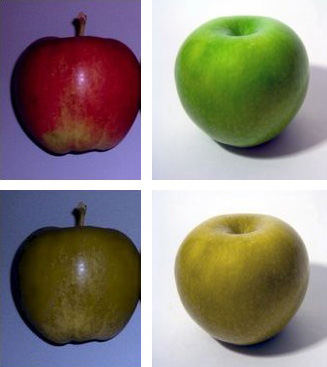
2014/4. Colorblindness illustrated. The illustration at II.22.3 below is doubtfully accurate for the difference between green and red colorblineness, and I can't find the exhibit on the website where it used to be. So I offer the following simpler illustration of two-cone color vision -- from a different website. On the left is a red braeburn apple which looks dirty yellow to a two-cone viewer, and a green Granny Smith apple that looks a lighter yellow to a two-cone viewer.
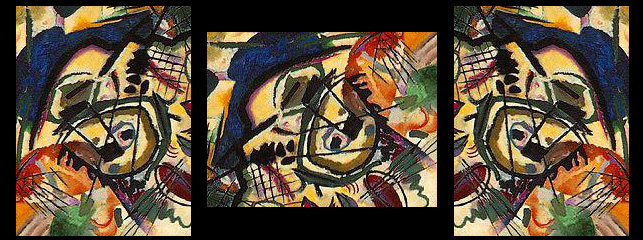
2014/4. Examples of ugliness. As an example of ugliness of form in painting the following detail from a painting by Wassily Kandinsky, Composition VII, World War I, is pretty good, iin my estimation. The whole work is much better, even though it is meant to represent the craziness of "the war to end all wars." I present the detail in two orientations and a flip of one of them.
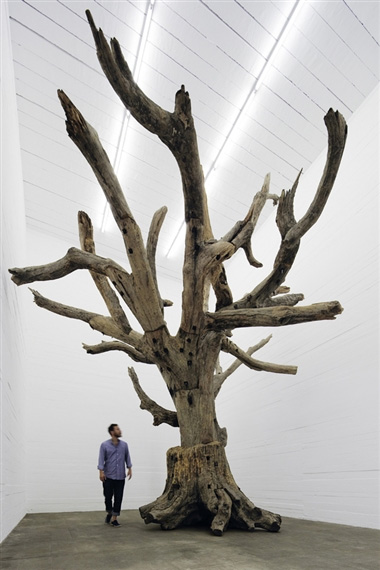
2014/5. An impressive sculptural work that challenges us to try to explain its beauty. Today on the net I got an image of the work illustrated below by the celebrated dissenting artist, Weiwei. I believe it is beautiful in a fashion, but I find it very difficult to give a convincing account of its beauty, that is, to say what its beautiful descriptive aesthetic properties are. So I can use it to illustrate the point made about aesthetic appreciation among less than ideal appreciators: recognition of beauty doesn't imply ability to explain one's response. Comments and suggestions are welcome.
2014/6. Revision of the paper assignment
The syllabus envisioned a single term paper due late in the semester concerning Scruton’s thoughts about this or that. It now seems far better change that to a series of short papers, one each week, concerning a topic of your choice in the chapter that is scheduled for discussion that week. The papers are due at the beginning of the first meeting of the week. They should run about two pages in length. I prefer that they be submitted by email but hard-copy submissions are not forbidden.
One motivation is to keep the class on the same page week by week and to spread the coverage of topics more widely. The papers will also keep me informed about what people are picking up from the assigned material. That way I can comment on the ways people are understanding (or misunderstanding) the material.
The short papers will fulfill the discussion item requirement for the rest of the semester, although the discussion file remains open for anyone who wants to discuss a point further or have my opinion on a question. I will respond to each of the papers, and grade them, hopefully by the second class period each week.
The first of the papers, concerning a topic in Scruton’s Chapter 2, is due by class time on Tuesday, November 11. We have room in the schedule for a total of five papers.
I. Notes added in 2013 (cited as I.1, I.2, etc.)
- Dwarfism and other problematic bodily proportions
- Properties of Taste
- Apollonian and Dionysian
- Functionally good proportions
- Beautiful balancing
- Could our experienced color spectra be reversed without our being able to tell?
- The concept of a disposition puzzles students needlessly.
- Trichromatic and tetrachromatic color vision: what does it tell us about sensory color?
- Extraordinary color vision in the wider animal kingdom.
- Mongolian throat singing.
- Faster and slower lines illustrated (subtly)
- Answers to exercise in identifying descriptive aesthetic properties, II.55 below.
- Midterm Test
- Diagram of levels in the updated sense of beauty theory
- Checklist of terms, phrases, and ideas re. the Midterm Test
- Other displays re. the Midterm test.
- Matisse's Joy of Life as a prime example of expressive line and color.
- Midterm test redeemed.
- The Pleistoscene ideal landscape.
- A Term Paper Advisory
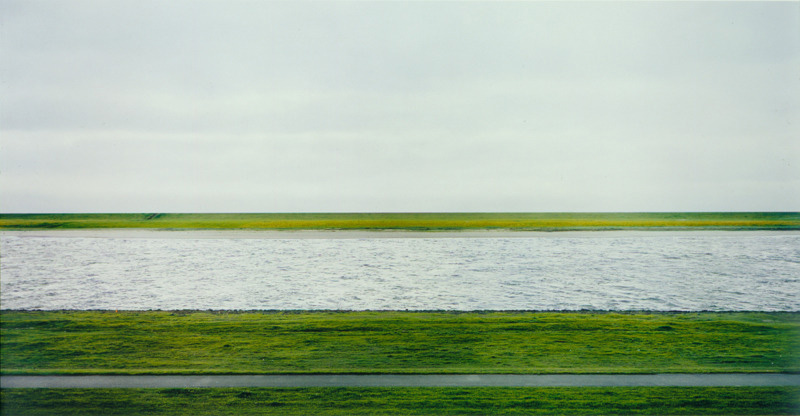
- Art Photography - an example of photo-minimalism. Andreas Gursky's Rhein II, 1999. Glass-mounted 350cm x 200cm (80in x 140in).
1. Dwarfism and other problematic bodily proportions (extending the discussion of Duerer's proportions).
Dwarfism often, though not always, is manifested in uneven growth of the major divisions of the body. Typically the legs are much shorter in relation to the torso, neck and head than in the normal human body. Are we right to regard such proportions as unbeautiful? With all due respect to the many admirable qualities of these people, I think we must take the proportions to be aesthetically unfortunate. A site to consult on the condition, one that aims to serve the interests of dwarfs,is: http://www.youtube.com/watch?v=pf3TgkKh7R4&feature=plcp .
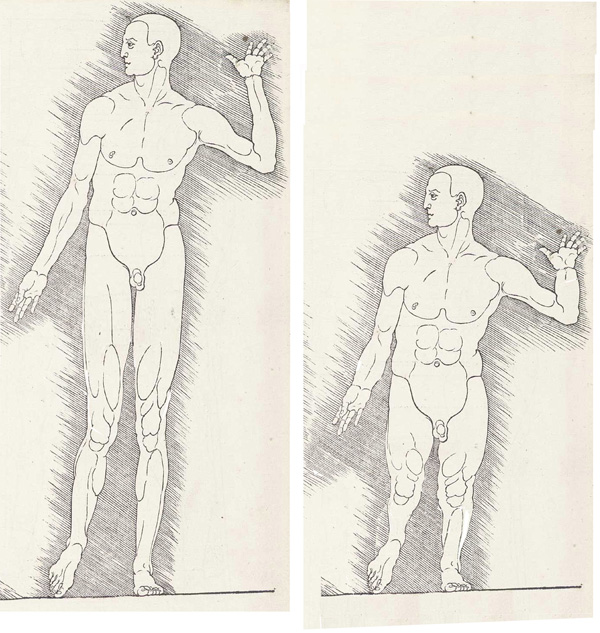
What other vertical proportions are rightly regarded as unbeautiful? A plausible candidate is a body with a very short neck, where the head seems buried in the torso. Likewise a person with an unusually large head, as in the Sotos Syndrome. Perhaps there are persons with overlong legs in relation to the torso -- I'm not sure (I can't cite any examples). Here are examples of Duerer taken to extremes. The question of why these are not accepted as ideal proportions is an interesting one. Is it just convention, or the difference from the majority model? Or are there objective reasons that should weigh with us?
Parts of the body can be disproportionately thick or thin. Lipoedema is a condition that causes legs and other parts of the body to swell to extreme fatty thickness. It's caused by lymph ducts being squeezed shut. Images, some rather horrific, are available at: http://en.wikipedia.org/wiki/Lipedema. No question but that these conditions are unbeautiful.
2. Properties of taste
Taste, or flavor, is particularly challenging. Much of what is called flavor is scent, as becomes apparent when one's olfactory receptors are masked. When olfaction is excluded there are four traditional flavor properties: sweetness, sourness, bitterness and saltiness. A fifth, introduced into scientific circles only in 1908, is called savoriness or umami.. The description of the last is somewhat puzzling because of the reliance on its effects rather than on its intrinsic properties. The Wikipedia article on it puts the matter this way: "It can be described as a pleasant "brothy" or "meaty" taste with a long lasting, mouthwatering and coating sensation over the tongue...Its effect is to balance taste and round out the overall flavor of a dish." This certainly sets it apart from the other basic flavors, since it isn't intrinsic to them that the flavor be pleasant or unpleasant. But perhaps umami can be recognized apart from its being pleasing or displeasing -- the reference to the hedonic effect may just be a convenience in pointing it out, not essential to its basic character. The biochemistry of umami is partly known."The sensation of umami is due to the detection of the carboxylate anion of glutamate in specialized receptor cells present on the human and other animal tongues." (Wikipedia) MSG is a popular additive that actuates these receptors.
The five basic flavors interact in countless ways with each other and with aromas and textures. But like aromas, they are not organized into well-ordered relations comparable to sounds or sights (forms and colors). This lack severely limits the possibility of compositions analogous to those in the visual and musical arts.
There are other sensations produced by chemical reactions to food: spiciness (hotness),coolness, numbness, metallicness, astringency, and heartiness. These certainly enter into our gustatory experience even if they are not technically tastes -- because not registered by taste buds.
3. Thoughts about the Apollonian/Dionysian classification.
a.
Art works have different aspects. Songs have music and words, novels have style, narratives, and themes. Clearly each of these aspects can be classified as Apollonian or Dionysian. Apollonian lyrics can be set to Dionysian music; more often the lyrics can be more or less Apollonian (or Dionysian) than the music. Obviously this complicates the classification of works. One might think that in general it's better to have all aspects Apollonian or Dionysian to the same degree -- or the same mixture throughout. But I'm skeptical that things are that simple and I suggest we keep an open mind until we collect much more evidence than we now have.
b. The application of these categories to lives raises lots of questions too. Is a predominantly Apollonian life better than a predominantly Dionysian one? More fundamentally, what exactly do such lives look like given the variety of occupations? Could an Apollonian go in for extreme sports? Perhaps not. Could a Dionysian be a surgeon? Probably she'd do better as a trader on Wall Street.
4. More about functionally good properties. Good proportions have been characterized as being those that facilitate achievement of human goods. I argued that this isn't reducible to practical advantage. Let me add a bit to this argument. It is true that graceful movements and positions in ballet can't be achieved with a body with overly short legs, as in the Duerer transform in 1 above. One might suppose this is just a causal disability. I think it's more "internal" than that. Even if you could leap to the same height with super-springy dwarfish legs, the pose you achieve at the top of the leap wouldn't be as graceful because the legs are too short. Here is a test of that claim.
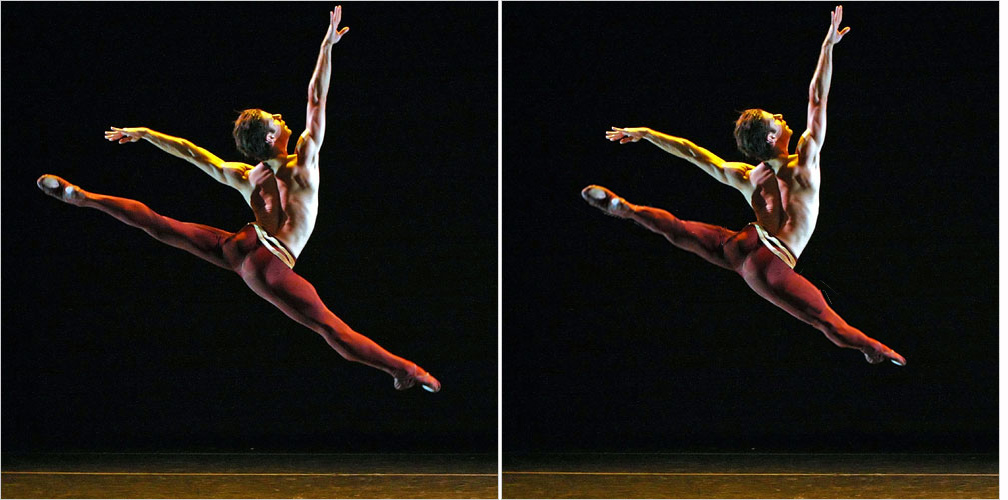 What do you think? Try to visualize the leaps achievable with the body on the right, assuming that the legs are springy enough to match the real Marcello Gomez on the left. Could they be as graceful as his leaps?
5. A stellar example of Apollonian beauty: beautiful balancing. A friend sent me this URL. I'll show enough of it in class to give you the idea. If you're interested, watch the whole, which I take to be a fine example of Apollonian beauty: beautifully graceful, controlled movement producing a beautifully delicately balanced composition. The performer is Miyoko Shida http://www.youtube.com/watch?v=K6rX1AEi57c
6. Could our experienced color spectra be reversed? This would produce the following comparison between experiencers:
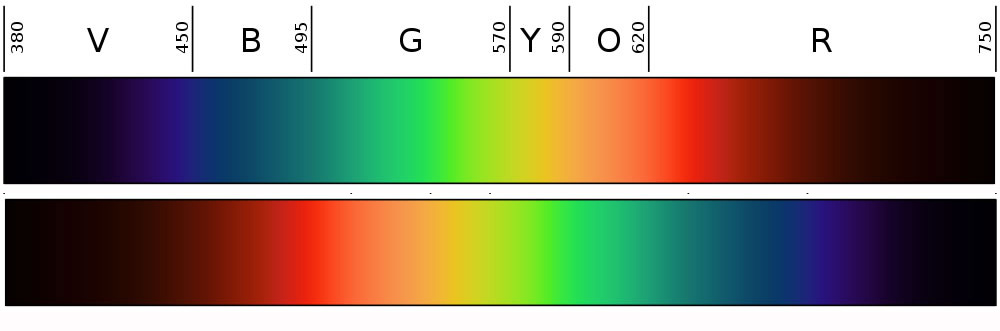 The argument in II.29 below gives reasons why a reversed spectrum would be in principle detectable. Study them carefully.
Use the two spectra as an illustration of the case.
7. The concept of a disposition puzzles students needlessly. Here are some reminders of key points, which are really quite familiar from our ordinary experience. They are non-controversial once we think clearly about them.
**Dispositional properties are very common in the physical world (powers, potentialities, capacities). For instance:
Solubility,
Magnetism,
Gravity,
Hardness,
Reflectance,
Poisonousness,
Nutritiousness, etc. They are part and parcel of oureveryday and scientific reality.
**These properties are possessed (are real) even when the disposition is not activated – even if the disposition is never activated. The salt is soluble in water even if it will never be put in water -- i.e. even if its solubility is never manifested.
**Many dispositional properties have highly complex activation-conditions. Complexity is a fact of the world, not a reason to doubt the reality of the disposition.
**The fact that no one would know salt was soluble if they had never seen it dissolve doesn't change the fact that it is soluble without relation to anyone's knowledge.
**A disposition isn't exclusively "in" an object; neither is it exclusively "in" the manifestation. It's a state of affairs involving both. The state of affairs is a hypothetical one.
**Response-dependent sensory properties (color, odor) are a special class of dispositional properties. They too are real even when the disposition is not activated, and even if the activating conditions are complex.
**The salty flavor of salt is a response-dependent sensory property. It is not exclusively in the salt (it's not an inherent property of the salt), and not exclusively in the experience of the taster; but in the hypothetical state of affairs of the salt causing the flavor sensation when and if the experiencer tastes it. This hypothetical state exists even when the salt is never tasted.
8. Trichromatic and tetrachromatic color vision: what does this tell us about sensory color? Bryan Rezende has referred me to a fascinating website on people who have four color cone-types: red, blue, green, and yellow.http://www.radiolab.org/story/211119-colors/?utm_source=local&utm_media=treatment&utm_campaign=daMost&utm_content=damostviewed
The fourth color cone gives them the capacity to see differences between color samples that trichromats cannot distinguish. For example one tetrachromat can see pinks around clouds in a blue sky. This enhanced discrimination responds to differences in wave-lengths, so the tetrachromat is seeing a real color within her field of vision that trichromats can't see. That means she is seeing the color field more accurately than trichromats.By extension, if a person had yet more types of cones he or she likely would see yet more color-differences -- where the light actually differed in wave-length, i.e., where the mixture of wave-lengths was different. Presumably the incidence of metamerism would diminish.
The criterion of the optimal color-discriminator would still apply, as far as I can see. And sensory color would still be a real (psychophysical dispositional) property. It would not be merely a subjective response. Indeed the example of superchromats, as they could be called, fits the general criterion perfectly. Color perception still reveals actual states of affairs -- but more or less precisely, depending on how precise one's color vision is.
It's also noteworthy that no tetrachromat experiences phenomenal colors (sense-data, qualia) that trichromats don't also experience. They just experience more varied qualia than trichromats do from a given scene.
9. Extraordinary color vision in the wider animal kingdom.The Mantis Shrimp has eyes on mobile stalks equipped with 12 photoreceptors for color perception, 4 for color filtering. It is able to respond to both polarised and to ultraviolet light, as well as colors perceptible by humans. Many birds, notably pigeons, respond to UV light and some have coloration that reflects it. Gender is often conveyed by such coloration. What phenomenal experience shrimp or pigeons have is uncertain. And there is no information on what aesthetic experience, if any, they have. If we had eyes like theirs, our phenomenal experience would be interestingly different from what it now is. But there is no evidence that the range of phenomenal qualities would be different; the difference would come in the distribution of qualities in a given color vision event. Since the distribution would correspond to a real distribution of physical color properties, the variation doesn't give reason to reject the reality of such sensory color.
However, one might wonder about the consequences of enhanced color-sensitivity in relation to beauty. Different phenomenal qualities would mean different beauties/unbeauties -- just as the colorblind person's aesthetic experience varies from that of a color-normal person's. A person can respond aesthetically only to the phenomenal qualities that are given to her. Of course! The colorblind person is responding on the basis of different data. Her appreciation may be right on target for those data, even if not appropriate to the object, say, a painting, as it actually is. (Further complication: suppose the painter had the same colorblindness as the viewer...)
10. Mongolian throat-singing, two sites for illuminating examples. http://andaunion.com/shop.php (the second selection, Hoorai, is recommended); and http://www.youtube.com/watch?v=0M3YFK3sJ54 (the whole is worth viewing). These serve to illustrate the subject of discussion in class and in Discussion Item #29. See if you agree with me about this admittedly somewhat weird manner of singing having significant beauty (even when the growly base tone is audible).
11. Faster or slower lines (subtly) illustrated. Here's the contrast I mentioned in class between two of the greatest draughtsmen of the 20th century, Matisse and Picasso. It's not the strongest contrast that one can find in the works of the two, but its subtlety makes another point of importance.
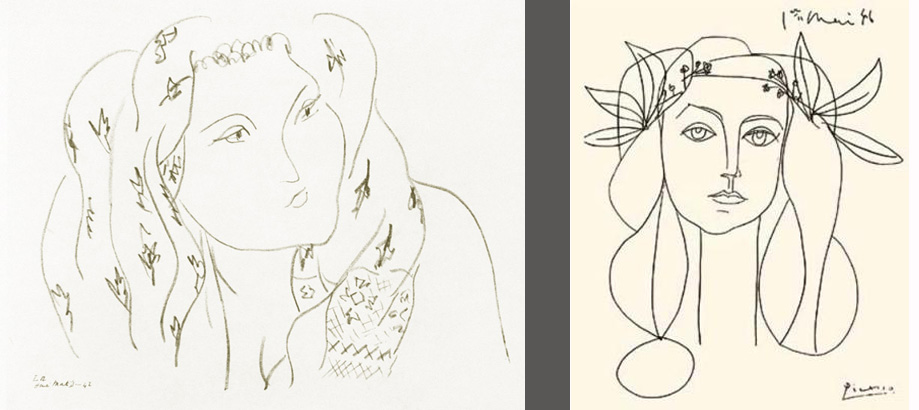
You can access lots of these artists' line drawings by Googling "Matisse line drawings" and "Picasso line drawings."
12. Answers to exercise in identifying descriptive aesthetic properties, II.55 below. The answers (mine, that is) are supplied for the three examples. Test your impressions by comparing them with my suggestions. Where there is a difference try to figure out what crossmodal connections are involved.
13. The Midterm Test [for 2013, NOT 2014]
The test consists of a single essay setting forth as accurately and completely as possible within the time constraints the updated sense of beauty theory of beauty – that is, the theory of beauty as a response-dependent property with the elaborate optimizing conditions and restrictions that have been set forth in the course material. The exposition should not cover the views of historical figures, though passing references where appropriate are fine. The emphasis should be on getting all parts of the theory out in the open in a well-organized way. To this end various guides and checklists have been provided, posted in the Beauty Notes file along with this description of the test topic.
Given the complexity of the theory, careful advance planning will be essential for a good performance. It is advisable to develop not just an outline but to write out a complete draft of an essay. Only in that way will the provisions of the theory get stated with anything like precision. Imprecision will destroy the credibility of the theory.
The task is not to argue for or against the theory but to expound it. But a good exposition will show at each step how this or that provision of the theory blocks a misunderstanding or misplaced objection or solves a problem that a simpler theory could not handle. For instance the response-dependent conception evades objections based on doubts about beauty being an inherent property. Likewise the definition of aesthetic pleasure as disinterested pleasure taken in descriptive aesthetic properties blocks claims that ultimately definitions of aesthetic pleasure are circular. Thus your exposition should make the reader aware of the reasons that sometimes lead adversaries to reject the theory.
Finally, the theory does not purport to prove that beauty is real. Rather it sets forth conditions that have to be met if beauty is a real property, not merely a matter of personal preference or social convention. Consequently the theory’s essential claim is that this is the only way beauty could be a real property. Consequently, if the theory’s optimizing criteria were fulfilled and the convergence it projects did not take place, beauty would not be a real property and all our beauty discourse would be about personal preference and social convention. The theory strives to minimize the chances of that result by not claiming too much objectivity or the wrong sort of objectivity. In this way it aims to stay true to such aesthetic powers as conscious beings can possess.
A good test essay will take most of the 75 minutes to write out. Remember that’s important to write legibly (and grammatically!). Otherwise the reader is apt to have a disagreeable experience reading it.
To help you remember key points, an outline (OUTLINE) may be brought to the test and used when you write your essay. It must not exceed 125 words (count them). Turn in the outline with your test booklet.
14. Diagram of levels in the updated sense of beauty theory.
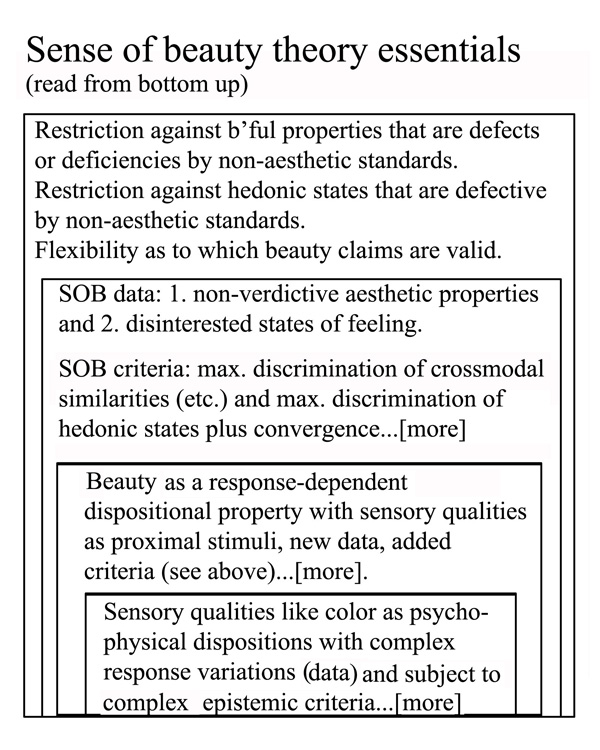
15. Checklist of terms, phrases, and ideas re. Midterm Test. Every good essay on the updated sense of beauty theory should make use of the following somewhere or other as the theory is being explained.
1. Response-dependent property
2. Phenomenal quality (quale/qualia, sense-datum/-a)
3. Inherent property
4. State of affairs
5. Activation of a disposition (manifested disposition)
6. Apparent color
7. Ostensive definition
8. Non-verdictive aesthetic property
9. Crossmodal similarity
10. Expressive/-ness
11. Adversive beauty
12. Defective/deficient emotional state/response
13. Optimal discriminator/-tion of ____
14. Optimal conditions for discrimination of _____
15. Aesthetic specialization
16. Beauty inaccessible to humans
17. Aesthetic knowledge
18. Personal preference among beauties
19. Love of unbeautiful things
20. Unbeautiful states of mind
21. Beautiful visual illusions
22. Easy (vs. difficult) beauties
23. Taste publics
24. Suitability for a taste public
25. Unbeautiful/ugly aesthetic properties
26. Functional beauty (not = practicality)
27. Formal beauty
28. Attributive (vs. predicative) use of “beautiful”
29. Adverbial beauty ascriptions: “beautifully____”
30. Beautiful properties/aspects
31. The object of one’s pleasure
32. Interested/disinterested pleasure
33. Defective/nondefective pleasures
34. Acceptable vs. optimal pleasures
35. Divergences defeating real beauty
36. Divergences defeating real color
37. Divergences confirming real color
38. Divergences confirming real beauty
39. Synaesthesia (vs. aesthetic perception)
40. The test of time
41. Good enough aesthetic responses/judgments
16. Other displays relative to the Midterm Test (TBA)
Basic ontological points to remember
1. For the beauty of a thing to be real = for statements about its beauty to be literally true or literally false. Most false claims are either overestimations or underestimations of the thing’s beauty, not claims in behalf of hopelessly ugly things.
This is the only reality requirement that beauty needs to meet in order to be real.
But note: the “thing” can be an object or event or state of affairs as a whole, or some part or aspect or property of an object, event, or state of affairs.
Great confusion comes from not being clear about exactly what the subject of a beauty claim is.
Beauty claims when fully specified are timeless and placeless.
A thing is beautiful to is worthy of admiring contemplation (G.E. Moore) – this assumes optimal conditions externally and internally.
2. The term objectivity is probably best avoided, or at least used with discretion, since it tends to produce confusion when one is talking about beauty. It’s enough to speak of beauty as a reality (as in 1 above).
Sundry questions about the USOB theory (Updated Sense of Beauty theory)
1. If sensory properties turned out not to be real properties, would that refute the USOB theory?
Short answer: No, but it would complicate the application of the theory to things.
2. Can pleasure or any other hedonic state be a valid indication of a real property?
Short answer: Not of inherent properties; but arguably of response-dependent aesthetic and moral properties; also arguably of the truth of theories.
3. What is the role of ostension (ostensive definition) in conveying aesthetic concepts including beauty?
Short answer: Very extensive! Crossmodal similarities can be conveyed only ostensively; beauty also, due to its heavy dependence on descriptive aesthetic properties – regardless of how many concepts figure in its full definition.
Longer answers to be given in class.
17. Matisse's Joy of Life (1905) as a prime example of expressive line and color.
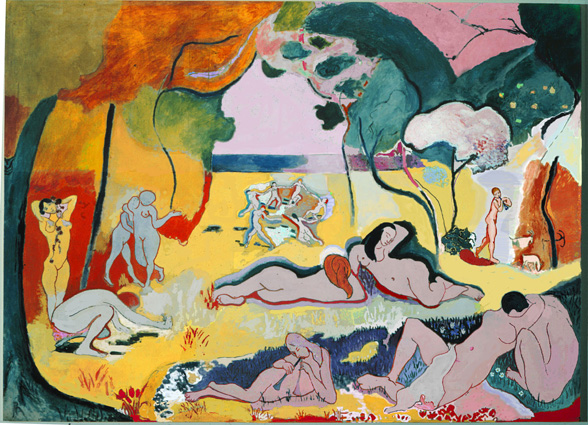
This will be discussed briefly in class before the Midterm Test and be referred to now and then in connection with Scruton. Since all aesthetic matters turn on comparisons (including contrasts) the image needs to be juxtaposed by one that is strikingly similar in theme but different in line and color.

Mel Ramos, Manet's Olympia, 1974. Lithograph.
18. A second bite at the apple: the midterm test redeemed
Few test essays gave what is essential for a high-rated exposition of the USOB theory, namely a single-sentence statement of the theory itself. Too often people gave bits and pieces rather than a connected exposition. They talked about the theory without ever stating it. The consequence is that a reader is not told what the theory actually says.
In retrospect I would have come down hard on the need for such a unified statement before the test. It didn’t occur to me to be necessary. Now, the test behind us, it’s still essential to remedy the deficiency because the success of the rest of the course depends on the theory being well understood. So I’ve hit upon the following plan. I’ve formulated a one-sentence statement of the USOB theory and allow those who wish to improve their grade to write an essay in which they explain each part of the statement. The essay should begin with the statement and proceed with the detailed explanation.
My hope is that the statement alone will focus your attention in the right way. But in looking over the test essays one weakness stares at me and leads me to add the following advisory. Give special attention to the optimizing conditions and the reason why they are needed. These are justified because they are basic to our cognition of the world; they help define what is meant by reality in every department of knowledge, including science. Thus any realist theory of beauty has to include them. Whether human aesthetic experience conforms to them is, of course, the ultimate question. But unless it does, beauty is not a real property of the world.
Here is the statement of the USOB theory.
Beauty is the capacity of an “object” to elicit a viewer’s disinterested, non-defective pleasure in the non-verdictive (or descriptive) aesthetic properties of the object when the object is perceived accurately (in accordance with the consensus of maximal discriminators operating under optimum conditions) in respect of its sensory properties and, where relevant, conceptual properties, and also in respect of the non-verdictive aesthetic properties that emerge from the sensory and/or conceptual properties; and where the pleasure is the pleasure that maximal, non-defective hedonic discriminators, operating under optimal conditions, experience over time.
The essay should be about as long as the midterm test essay. It should be written in well-edited English without category mistakes or other infelicities. The final grade for the midterm test component will be based on the in-class version and the new essay (where there is one), with greater value accorded to the out-of-class essay. I would expect the final grade to be better than the in-class grade.
The due date for the essays is Wednesday, Nov. 20 at midnight. Submit the essay electronically in an email attachment.
19. The Pleistoscene ideal landscape. (Venezuela savannah, actually)
 Just stock it with plenty of animals, like the Serengeti in Africa in a National Geographic TV program, and you'll have it.
20. A term paper advisory. People are asking for more guidance on the paper. Here are some suggestions – which I’ll preface with a request that you read the statement in the syllabus thoughtfully, since it covers the essential points.
Normal philosophic reading should be demanding. The reader should constantly ask, is the opinion that is being put forward really solid? Is it clear just what is being said? Is the problem partly about vague or ambiguous terms that have to be clarified? What would be needed for a definitive resolution of the problem the opinion addresses? Is the opinion consistent with the best available knowledge on hand? If it is, what impact should it have on our beliefs? And so forth.
If you read this way, you should find yourself questioning a lot of Scruton’s statements – not indiscriminately, of course, but where they are vague or overblown or contestable in some other way – sometimes because he has compressed his discussions to fit within “a very short introduction.” You don’t have to be hostile. Being helpful in clarifying and filling in is just as good as correcting – everything depends on what is most reasonable given the claims you take as your topic.
In studying a particular issue, keep in mind the findings arrived at already in the course, from the truisms onward. Lots of distinctions have been drawn, lots of points made about beauty, its many varieties and degrees. All that should be put to good use in dealing with the present topics.
Currently we are studying Scruton’s views on natural beauty. Among the topics in Chapter 3 is that of the beauty of animals, plants and other natural things. On p. 50 in reference to Kant Scruton speaks of the “perfection of form and intricate harmony of detail” of natural organisms, qualities that “speak to us of an order that lies deep in ourselves.” That raises two questions: how perfect is the form and functioning of animals and what relation is there between our appreciation of those creatures and our self-appreciation. There’s a rich theme! Certainly it’s too big and complex to exhaust, but there are parts that you could develop to good effect. Ideas regarding the comparative beauty of animals are offered in Beauty Notes; other ideas will be offered in lectures and class discussions.
The same general pattern occurs in Scruton’s other chapters. The topics are there and material for dealing with them is offered. They just have to be retrieved and made use of.
I’m available to advise on a particular topic. But you should first find the topic and do the preliminary assembling of relevant material. Then we can talk to better advantage.
21. Art Photography - an example of photo-minimalism. Andreas Gursky's Rhein II, 1999. Glass-mounted 350cm x 200cm (80in x 140in).
II. Prior notes (cited as II.1, II.2, etc.)
- Procedural suggestions.
- Thoughts prompted by the
first lecture class discussion.
- A key ambiguity in
"the reason why Mary finds that beautiful."
- Labrets -- are they
beautiful? What do tribal members find good about them?
- Fat culture among Mauritanian nomads.
- Sexual attractiveness and beauty (2)
- URL on the feeling of
fullness in relation to aesthetic enjoyment of food.
- What would it take for cuisine to become fine art?
- The golden section properties within the mystic pentagram
- Facial beauty and the golden section
- Polykleitos's "canon": golden section analysis
- Faces made symmetrical
- Thoughts on the beauty of animals
- Animals compared with humans in respect of beauty
- Gulliver's problem, part 2
- Terms for beauty and its
opposite.
- Beauty and goodness
- Cicero's notion of the idea in the artist's mind
- Questions on Plato's theory of beauty
- Plato's dialogue Hippias Major, which concerns the definition of beauty
- Color exhibits re. the sense of beauty theory
- Color temperature, re. aesthetic properties of color.
- Synesthesia is different from crossmodal perceptiveness.
- Color symbolism
- Diagram of the dispositional conception of color.
- Diagram of the dispositional (response-dependent) concept of beauty.
- What properties do properties have? The example of color.
- Color and its complications. How do we know all normally color-sighted people have the same color experiences?
- Evidence for the universality of some cross-modal resemblance-responses.
- Functional beauty
- Simple beauty
- Natural beauty
- Strange problem of beautiful mutilated sculpture
- A sense of beauty essential
- Sense of beauty criteria of accuracy: three levels
- Ideal vs. ordinary aesthetic appreciation and judgment
- Scruton on truth, goodness and beauty further analyzed.
- URLs for Scruton, Ch. 1.
- Scruton re. the "intentionality" of disinterested pleasure, and an alternative proposal.
- URLs for Scruton, Chs. 2 and 7
- URLs for Scruton, Chs. 3
- URLs for Scruton, Ch. 4
- URLs for Scruton, Ch. 5
- URLs for Scruton, Ch. 6
- URLs for Scruton, Chs. 8ff.
- On love: what we can learn from Charlotte Brontë's Jane Eyre.
- Commentary on Jane Eyre's description of Rochester.
- An example of a near relative of love of a person in Jane Eyre
- A further thought on bad reasons for subjectivism (or nihilism) about beauty
- On the possibility of altruism.
- The Nature of Happiness
- How does the material all relate?
- Images relevant to Apollonian vs. Dionysian beauty.
- Aesthetic Property Exercise
- Examples relevant to questions about the U&V or other criteria of beauty in natural organisms
- Visual balance: Mondrian options re. balance
- Further thoughts about the capacity of the different sensory modalities to provide artistic media
- Paul Erdos, "the man who loved only numbers."
- Pythagorean Theorem proved by a simple diagrammic demonstration.
1. Procedural suggestions. (1) In case you find it
more comfortable to read texts with narrower pages than appear in the course
files when displayed at 100%, I suggest that you try reading them at 125%. I
find this easier on the eyes.
(2) For ease in referring to different parts of TOB I have inserted page
numbers. These occur in the center of the page. Don't think they are section
numbers.
(3) In the lecture outlines are URLs for various websites relevant to the
subject of the lecture. I don't always have time to access these in lectures,
but I strongly encourge everyone to view them during
the study time devoted to the course. Sometimes I play a Youtube video
before the class is due to begin. Not everyone will have arrived. But everyone has
the chance to view it at leisure and I hope everyone will. Click on the URL on the lecture outline.
2. Thoughts regularly prompted by discussion in first lecture in the course.
a. The following were among the questions that arose in class discussion. I
won't give my answers to them now because it's vital for you to ponder them,
draw relevant distinctions that clarify them, and connect them with such
evidence as you have or can get from outside sources and your own experience.
By the end of the course we should have good answers to them, answers that are
well-developed and plausible.
Does
cultural conditioning determine beauty-judgments?
Does sexual
attraction determine beauty-judgments?
Can
beauty-judgments override our emotional response (or lack of it)?
Can one
culture’s beauty-judgments be better than another’s?
b. Anyone keenly interested in natural ugliness may want to read the article posted on my website under that title.
3. A key ambiguity in "the reason why Mary finds that beautiful." This can refer to (1) the causal background that led to Mary's aesthetic liking, say, Samuel Barber's Adagio for Strings. But it can also refer to (2) Mary's reasons. These are the things that Mary finds likable about the piece. Mary's reasons will always be properties of the piece that she enjoys aesthetically. That is, it will be what Mary finds beautiful in the piece -- the quiet melody, the stately rhythm, etc. This need not be at all the same as the causal background. Suppose she has recently received a hearing aid that allows her to hear the music more clearly than before. This is part of the causal background but is no part of her reason for liking the piece. Similarly Mary may have been taught that Barber's Adagio is a great work. But that will not be what she likes about it, hence not part of her reason for liking it. (It will not be a musical liking, so to speak.)
4. Labrets in tribal societies: are they considered beautiful? If not, why wear them?

The Mursi peoples of southern Ethiopia offer examples
of what seems like grotesque body deformation, as shown below. A recent study
provides evidence of the way lip plates, which run up to 5 inches in diameter)
are viewed by tribespeople. Shauna LeTrosky, "Reflections on the lip-plates of Mursi woman as a source of stigma and self-esteem"
(2006) http://www.mursi.org/pdf/latosky.pdf.
LeTosky’s conversations with the Mursi
clearly bring out five sources of attraction of the lip plates.
The grounds revealed are these. (1) Labrets are an emblem signifying sexual
maturity and, when married, fidelity to one’s husband. (2) Labrets are a sign
that the wearer is not lazy or negligent: this may have a direct effect on the
bride price a suitor is willing to pay. (3) Labrets aid a woman in adopting a
dignified and calm manner of conducting herself, avoiding girlish haste. This
and the preceding consideration enhance the woman’s self-esteem. (4) Labrets
are money makers because they attract tourists who pay for photographing
wearers. (5) Labrets are a sign of respect for one’s cultural identity as a Mursi.
The down side of labrets, aside from the pain associated with stretching the
lip and inconvenience of keeping it stretched, is that drooling is unavoidable.
Many young Mursi, male and female, object to this.
All in all, the field evidence gives no support to the idea that labrets are
regarded by the Mursi as enhancing the appearance of
the face, as opposed to the value of the decoration, if any, on the lip plate
itself. The closest thing to this is the beautiful behavior, the serene and
confident manner that is induced by wearing the labret. But this is only an
effect of the labret. It does not make the wearer's face beautiful in and of itself.
Websites showing lip plates of various sorts, how they are removed, how one
drinks when one has then in both upper and lower lips, etc. may be found at:
http://www.youtube.com/watch?v=V2oRlK_wI_s&NR=1
http://www.youtube.com/watch?v=2PXbWYwmcCQ
http://www.youtube.com/watch?v=nIuDeoOERe0&feature=related
Claims are made about the beauty of the practice by outsiders but not (so far
as I have been able to discover) by the tribe members themselves. I don't find
these outsider claims credible regarding the effect on the face. Do you?
The Amazonian Kayapo lip disk shown above, some 2 1/2
inches in diameter, is worn by Raoni Metuktiri, a Kayapo chief and
activist in the effort to preserve tribal lands, most recently from inundation
by the Belo Monte dam complex. He is a locally renowned orator who has
attracted worldwide support for his struggles. Whether his
labret makes his presence when speaking more commanding is an interesting
question which I lack the data to consider. But it is hard to find any
beauty in the appearance produced when the face is shown in photographs.
5. URL for Mauritanian nomad culture of female obesity. http://tribes.tribe.net/nomadhelp/thread/b64d6be7-4ec6-465a-a196-ae081524a504#2a268b2f-ecde-46b2-adc1-4eeb25b09623 ; also a three-part article: http://www.marieclaire.com/world-reports/news/forcefeeding-in-mauritania .
6. Sexual attractiveness and beauty (1)
Much has been made of the connection between aesthetic preferences in the case of potential sexual partners and sexual allure. There is no reasonable doubt that beauty of appearance and behavior may enhance sexual attraction. However, it is not plausible to think that all sexual attraction is aesthetic (let alone that all aesthetic attraction is sexual). I want to suggest a criterion which distinguishes sexual and aesthetic attraction. It may or may not succeed but at least it should focus your minds on the issue.
The idea is simple. Any genuinely aesthetic attraction that contributes to sexual attractiveness must continue to be attractive when the sexual component is absent. That is, when sexual desire is not a factor. What does that amount to? Since sexual attraction is definable in terms of the effect of the thing in question on the erogenous zones, since they are the locus of sexual desire, the attraction will be aesthetic only if it persists when the erogenous zones are not stirred by contemplating the object, the face or figure that is at issue. But, you may say, how can we test that if our erogenous zones are always stirred? Perhaps you can't, if that's true of you. You have to wait a while, maybe a long while! Or you have to look to persons of a different sexual orientation to see whether the features that allure you allure them without awakening sexual desire.
But perhaps there is another way. Do the kind of analysis of the relations of lines and forms within the face or figure that explain its beauty. Then compare these reasons with ones that apply to sexually neutral beauties. If the reasons turn out to be much the same, then isn't there good reason to believe that the face and figure you find beautiful would continue to seem beautiful and would continue to give aesthetic pleasure even though the sexual connection lapsed?
If that is generally the case, then isn't aesthetic attractiveness in and of itself distinct from sexual attractiveness and the relation between them one of causality and not identity (in whole or in part)? In that case we could say that a thing may be sexually attractive because it's beautiful but it can't be beautiful merely because it's sexually attractive. Note that mate preference is not the same as sexual attraction because the latter isn't the only factor in selecting a mate, is it?
7. Sexual attractiveness and beauty (2)
I. Preliminary thoughts
A common belief nowadays is that personal beauty is what people find sexually attractive. I think this is a gross oversimplification. What is the real connection? For surely there is some. Sexiness plays too large a part in art, personal adornment, and mate choice for the two to be entirely separate. Let's list some plausible connections.
Perceived ugliness of face or form seems a sexual turn off, other things being equal. If this is so then not being grossly unbeautiful is a necessary condition for sexual attractiveness. But clearly being at least OK-looking is not a sufficient condition – again, other things being equal. Let's call persons who aren't ugly but aren't beautiful either, plain. Then we can say that many plain persons are sexually unattractive. At the same time many plain folk can be tolerably sexually appealing given other attractants, such as the right pheromones or wealth, power, style or charm.
On the other hand beauty of face or form of an adult tends to be a sexual turn-on in normal circumstances -- depending of course on one's sexual orientation. Often it is sufficient.
The sexual attractiveness I have in mind at the moment is what one can appreciate without knowing about wealth, power, style of behavior, personality – and out of range of pheromones – and one's view restricted to face, head, stature and figure seen in simple fitted but not skin tight clothing. (There are lots of factors, once one gets down to specifics.) Of course in life we usually have more data than that to respond to. But sometimes considerably less. Sometimes we see only the face. Discussions of beauty and sexiness are seriously vague and prone to misunderstanding when the conditions are unspecified. There is not just one question about the connection between beauty and sexual attractiveness. There are a hundred.
What sort of personal beauty (of face, figure, skin and hair) if any is sexually neutral? The cuteness of a child, especially an infant, is almost always neutral except for pedophiles – though if we were hooked up to electrodes there might be preconscious sexual leanings in the rest of us – we can't rule that out just because we don't feel them. What is clear is that if there are any sexual undercurrents they are overridden by our conscious selves, blocked before they cause sexual sensations. The quality of skin that would be deliciously erotic in an adult sexual partner is just delicious to see and touch in a child – the way a flavor is delicious to taste. It is sensuously attractive without being erotically so. The difference comes down to absence of effect upon our erogenous zones and our minds not being turned toward that erotic effect.
There are also strong sexually off-putting aspects in our experience of children – roughly, the childishness of the child, which suggests lack of sexual susceptibility and capability. The child's lack of adult sexual attributes reinforces this appearance of sexual innocence. The child's beauty is in this way mostly free of suggestions of the erotic, notwithstanding the fact that even babies are capable of erotic pleasure.
There is also something liberating about sex not getting in the way of simple affection, i.e. desire for and enjoyment of the well-being of the child. The child offers an ideal arena for enjoyment of this sentiment (except of course for pedophiles). And it harmonizes with our sense of ourselves as nurturers of the child.
The post-pubescent human with well developed secondary sexual attributes brings new bodily properties into the picture – females especially whose breasts and pelvis are foci of erotic interest (of reasonable erotic interest, I mean). For men it is mainly the pubes that play this role. Males appeal sexually to (heterosexual) women largely by looking old enough to perform sexually. But also the male role as protector seems important. Hence the premium placed on muscular development. A number of other traits count as secondary male characteristics: face and body hair, enlargement of Adam's apple, deepening of voice, greater mass of thigh muscles in front of the femur, etc. Some seem sexually attractive, others are questionable. Perhaps some are not themselves sexually appealing but only signs of sexual capability. To be sexually appealing I think they have to intensify the pleasure of actual sexual engagement in coitus or its preliminaries or aftermath: kissing, embracing, caressing, fond gazing, etc.
Since I feel less qualified to discuss the allure of males either to heterosexual females or to homosexual males, I'll concentrate on the appeal of females to heterosexual males. The curves of the body are an obvious source of allure. What might be called slender voluptuousness is highly attractive. Why? Because it suits a variety of comfortable and stimulating sexual positions and movements. Corpulence is unattractive because heaviness, sluggishness, and pendulous fleshiness is sexually limiting. Even ponderousness may be erotically stimulating in some postures but it lacks the variety of erotically pleasing aspects found in slender, agile voluptuousness and therefore typically comes off as low grade. Normally it will not be chosen if a non-ponderous option is available. The existence of fat sex internet sites does not prove otherwise.
Our sex life is a mixture of pleasing sensations of orgasms and the non-orgasmic sensuality that extends and prepares the renewal of orgasmic sensations. That latter sensuality consists of milder sensations induced by caresses, embraces, kisses, aromas and warmth of close presence, feelings of hair in one's face, etc., these and muscular stretchings and compressions. And of course the exchange of feelings, the sense of the other opening herself, striving and relaxing. All this. Ideally there is much harmony within and between partners and, since harmony is a species of beauty, much beauty.
There is also a lot of fantasy sexuality that runs the gamut of courtship, foreplay, coitus, aftermath, and sex partner interpersonal behavior, narratives of rivalry, deception, jealousy, etc. This involves much imagined beauty.
Physical and behavior attributes that are seen as lending themselves to this aspect of our lives will be sexually attractive. They may support our sexuality in various ways, not just by arousing sexual desire. For example a pattern of behavior may extend the satisfaction of coitus instead of arousing fresh desire. Such an ‘afterglow' pattern contrasts with one that interrupts the aftermath too soon or continues caresses beyond their useful term. In sexual attractiveness it is not just what invites us to coitus that matters. Retrospection is also significant. We want not only for love-making to go well but also for the loving after-time and the on-going engagement with the lover doing a whole host of things to be given full scope. This figures importantly in the sexual attractiveness of a person, especially to one who thinks things through.
Sexually attractive styles of clothing, the plunging neckline, the bare back, the flaring skirt that could easily be flipped up, etc., contrast with the shapeless gym suit or figure-concealing nun's habit or burkha. (Should one distinguish between sexually attractive and sexually provocative?)
Can well-formed female bodies whose good form includes secondary sexual attributes ever be sexually neutral? Perhaps not. Well-formed breasts and buttocks, an hour-glass torso, a neck that lifts the head well above the clavicle, legs long enough for the torso, straight enough and curvaceous enough (swelling calf, narrow ankle), and feet of moderate size seem necessarily attractive. The face is more variable since its expressions make so much difference. There is no such complication with the rest (without behavior entering into the picture).
II. An attempt at summation
1. Modes of sexiness. We can classify sexiness in various
ways, including these:
1. First-sight sexiness at a distance (charm not displayed)
2. Close-up sexy appearance (charm not displayed)
3. Public behavioral sexiness (public behavioral repertoire
displayed)
4. One-on-one behavioral sexiness (personal behavioral repertoire
displayed)
5. Intimate sexy appearance (charm not included)
6. Intimate sexiness (intimate behavioral repertoire included)
These are rough rather than sharply defined modes of sexiness. Often at a distance outward form carries suggestions of charm in the way the person carries herself. But because these suggestions can be demolished by more exposure to the behavioral repertoire (even the public behavior one) they do not entitle one to presume charm. Similar remarks apply to the other modes. In general, a person may be sexy in one mode and not in various of the others. Intimate sexiness may be abundant without the person having much public behavior sexiness. The reverse is also true.
In the behavior component in 4 and 6 I include the signs of sexual interest in the person toward whom the behavior is directed. This is a major contributor to overall sexiness, especially when the interest is informed by knowledge of what good sex is.
2. Degrees of sexiness are roughly fixed by how many of the modes a person exemplifies and how fully they are exemplified. How precise the comparisons can be made is uncertain. This applies even within modes but especially among different ensembles of modes. Still, many well-founded comparisons can be made based on normal (non-pathological) human responses. Sexiness in general will be the capability of a person to arouse, by appearance and behavior, sexual desire in others for engagement with him/her. Since there are many pathological erotic responses of varying degrees, giving an exact account of normality is a challenging task. But some limitations can be justified. For example behavior that is submissive is not always welcoming, as genuine sexiness is. Lukewarm submissiveness may be enough to turn a predator on, but it is not sexy behavior. Even less is sincerely prudish behavior sexy even if it poses a challenge that a predator finds exciting.
How can we understand the seductive effect of wealth and power on a person's sexual allure? I suggest they only serve to increase the desirability of a personal relation with the person without actually increasing the person's sexiness. The gain in these other attractions may allow whatever sexiness the person has to be more easily appreciated. But the sexiness itself must be independently evaluated. Of course the lover may be motivated to fantasize more sexiness than exists in order to enjoy the benefits. Another twist is that the lover may focus on the sensuous pleasures that luxury will bring (perhaps with some extra-curricular sexual flings thrown in).
3. Beautiful sexiness . If we follow the general pattern for other domains of beauty, we will understand beautiful sexiness as intense, non-defective sexiness. Clearly the task of vindicating this criterion centers upon the concept of non-defectiveness. Here's where controversy will rage. The non-defectiveness in question should be judged by the impact of sexiness on the quality of life attainable under reasonable social conditions. Obviously social conditions can distort the impact. In puritanical societies sexiness might be harmful to the possessor. But so also in permissive societies the possessor of beauty of this sort may be a target of predators or the envious hostility of rivals. So a criterion of non-defective (non-prejudicial) social conditions will be needed to make the criterion work. Naturally that will be a subject of intense controversy. But any defender of beautiful sexiness must address it.
The criterion implies that intense sexiness can be defective even under reasonable social conditions in a well-ordered society. Because of the presence of normative criteria in sexiness itself, showing that this is a genuine possibility can be ticklish. What sort of ‘internal' defects can there be in sexiness? One is indiscriminately or indiscreetly displaying one's sexy features too fully or frequently. That's a defect in the behavior repertoire. That doesn't make the physical features any less beautifully sexy. Can physical features be intensely but defectively sexy? Perhaps they can if one part of the body, say the bosom, is too sexy for the rest of the body. Imagine a large, well molded bosom on a body that is well shaped in a slender mode. This disproportion (disharmony) may make the virtues of each part hard to appreciate. Even more suspect is the case of oversized sexual attributes which looms large in popular macho culture. That deserves a separate section.
4. The problem of oversized attributes. Oversized breasts are the chief example. Are grossly overlarge breasts sexier than more proportionate ones? Visiting any of the many big breast internet sites will provide a cascade of images that put this to the test. Many of the breasts on such sites are grotesquely large, unmanageable, and ill-fated. It doesn't do to think of them after aging sends them south. Surely most of them aren't beautiful even when in their prime. Still they tend to turn normally sexed males on even when the males are fully aware of the downside. How do we explain this sexy-lookingness? And what relation to beauty can it have?
I suggest, first, that in certain positions most are sexy-looking. Especially when the model is on her back their size seems lessened, their pendulousness doesn't show at all, and their broad curves may be beautiful to stroke and nuzzle. This means that in certain limited respects (in some positions, from some angles) some of them have some beauty. They don't make it overall, however. Their negative points are too great. From many angles and in many positions they are typically absurd, ridiculous, appalling. Not only are they not beautiful overall. They aren't even sexually attractive when their totality is realistically reviewed. (In bed is one thing, on the beach another.)
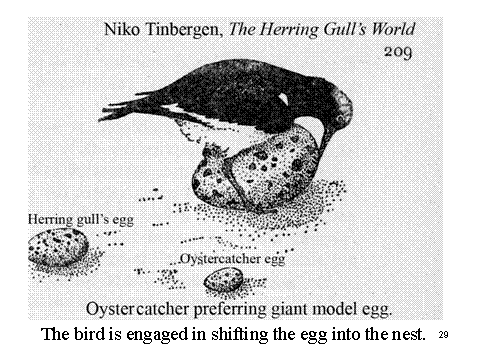
But still, the male erotic response tends to override the negatives. That
seems linked to what is called a “peak shift” in the animal world. A
manifestation of this is shown in the following illustration of an
oystercatcher trying to move an absurdly large (fake) egg into its nest in
preference to any it could actually brood.
Our Pleistocene inheritance is one likely source. At some level the male sex drive seems to have been left without a sensible upper limit regarding sexual attributes. But there is another likely factor, namely the restraints that social living places on this drive. Most men live lives of continuous sexual frustration, which predisposes their eyes to be bigger than their stomachs, as the saying goes. As starving people have outsized appetites (at least at the beginning of a meal), so sexually undernourished males at some level desire outsized erotic attributes. Big breast arousal plausibly results in part from this.
The same syndrome produces male fantasies of oversized penises, as in
Japanese erotic art. Example are displayed at: http://www.gregkucera.com/_images/shunga/sh_couplegreenrobe.jpg
http://www.robynbuntin.com/japanese/g_japanese_ind.asp?ProductID=14620
What this means is that the spontaneous responses of normally sexed men do not
provide an entirely reliable criterion of beautiful sexiness. They (or their
sexual systems) are prone to a kind of illusion. However this
bias can be overcome by ‘top-down' self-management. This is true
both for our assessment of the intensity of sexiness and its degree of beauty
or unbeauty.

Website for oversized female attributes: http://www.bigbreastarchive.com/
For an all-around, non-porn site on women's breasts,
there is the Female Intelligence Agency: http://www.007b.com . It has lots of comments by women readers about self-image and
male-relationship problems.
8. URL on the feeling of fullness in relation to aesthetic enjoyment of food. http://www.kidslink.co.uk/blog/ This is obviously relevant to the notion that fine cuisine might be, or become, beautiful in the manner of fine art or at a level comparable to that of fine art. Scroll down to the article, "The Feeling of Filling."
9. What would it take for fine cuisine to be raised to the level of a fine art? The example of molecular gastronomy.
A article in Vanity Fair, October 2010, "It was delicious while it lasted," by Jan McInerney, discusses the innovative cuisine of Ferran Adrià, a Spanish chef who is currently considered at the very top of world chefs. Here are some passages relevant to the question of his cuisine as genuine art.
…in 1987—the same year that Adrià became sole chef de cuisine —he decided after listening to a lecture by Chantecler chef Jacques Maximin to try to invent his own cuisine. “Creativity means not copying,” Maximin declared in answer to a question. “This simple sentence was what brought about a change in approach in our cooking,” Adrià wrote later, “and was the cut-off point between ‘re-creation' and a firm decision to become involved in creativity.” That year Adrià decided to close the restaurant for five months in the winter—a period later extended to six months—to devote the hiatus to experimentation and creation.
“In 2001, when El Bulli was becoming very well known, the logical thing would have been to open year-round. But, for us, the most important thing was creativity. So we decided to close for lunch, and the level of creativity kept getting higher. But at some point I realized we wouldn't be able to continue to evolve as a restaurant.”
In 2014, El Bulli will reopen under a different format, one that probably will not accommodate paying customers. “It will be kind of a think tank,” he says. “Not a school exactly, but a foundation. A private nonprofit foundation.” He still seems to be defining and refining the concept, improvising. “We'll have 25 people here, chefs, two or three journalists, tech people. At the end of the day our work will be posted on the Internet. We will collaborate with the world of art and design…Every year will be different.”
“There aren't enough professionals dedicated to analysis and research,” he says, drumming the table in from of us. “This is work that people are doing at universities. There will be cooking at Harvard.” I would have scoffed at this notion if I hadn't already read that Adrià is bringing cooking to Harvard this fall, presiding over a course called Science and Cooking: From Haute Cuisine to the Science of Soft Matter .
Says Tony Bourdain, “The word ‘artist' can't and shouldn't be used in respect to chefs—with very few exceptions. Ferran Adrià is, without a doubt, an artist. I always find myself comparing Ferran to musicians—rather than other chefs. People like Jimi Hendrix … or Charlie Parker, who heard notes, heard music, where others heard nothing, who made noises come out of their instruments that no one else had ever dreamed possible. I don't know—but suspect—that Ferran, like Hendrix, like Parker, might find it a burden year after year to be that far out in front of everybody else. I can't imagine what that pressure might be like.”
Videos of the amazing dishes created by Adria can be found at: http://www.youtube.com/watch?v=mS0rttp9EIE
The article itself is available at:
http://www.vanityfair.com/culture/features/2010/10/el-bulli-201010
The videos make it clear why the term "molecular gastronomy" came into use. The ingredients are really reconstituted from the molecular level up.
10. The golden section properties within the mystic pentagram
Responding to questions that typically arise in class about the golden section aspects of the Pythagoreans' famous emblem, I first present the thing itself, big enough to be seen easily, using the illustration from H. E. Huntley, The Divine Proportion: a study in mathematical beauty, New York: Dover Publications, 1970, with some supplementary lettering and lines. The Greek letter Ø signifies that the golden ratio holds between the line and the side of the pentagon that stands opposite to it, for instance B'R is to RQ as B'RQ is to B'R.
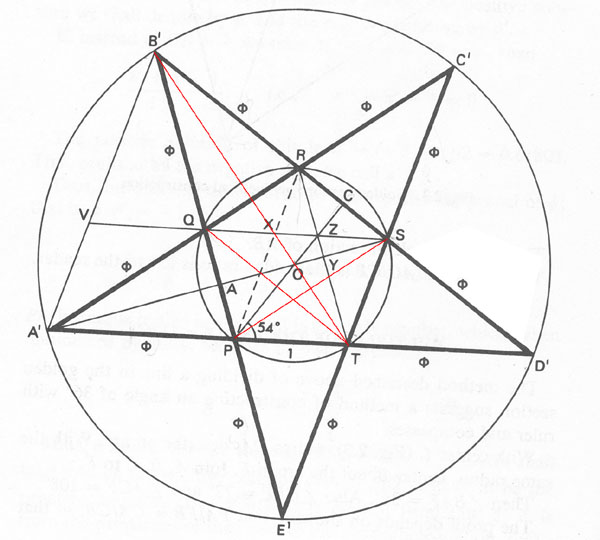
Notice that the additional Greek letters Ø are justified by the relations of the segments to the sides of the pentagon. By the same token the red lines SP and QT cut each other at a golden section cut just as the one mentioned in Huntley's passage does. Similar additions can be made to a number of other relations Huntley mentions. Here is the substance of his list. Note that bold face numerals will have to do for superscripts, which don't copy through from Wordperfect to Dreamweaver.
Let PT = 1. Then PQ, QR, RS, and ST = 1.
Then A'P = Ø, OA/OS = Ø/2, OA'/OS = Ø2, OA'/OA = 2Ø.Further: QS, QT, RT, RP, SP, ST, = Ø;
And where X (Z, etc.) is the intersection of two diagonals, the segments are in the ratio of Ø -- note the additional intersections supplied by the diagonals in red.
In addition: SQ extended to V produces the following instances of Ø: B'V/VA', B'Q/QP, B'X/XT, B'S/SD'; parallel instances are produced by extension of the other diagonals (SP et al)
If that weren't enough, the lengths of B'D',B'S, B'R, RS, RX and XZ are in geometric progression:
B'D' = Ø3, B'S = Ø2, B'R = Ø, RS = 1, RX = Ø-1, XZ Ø-2
Is that enough? Huntley's list goes on for quite a bit.
11. Facial beauty and the golden section
Several years ago a student referred the class to a website concerning facial beauty. It has a lot of fascinating illustrations, so I added it to the course material. Just how much it proves about the golden section is another matter which we will discuss in due course. But visit the site and familiarize yourselves with its content. Explore the more relevant of the links (e.g. eternal beauty).The address is of the nearest successor of this site is:
Observations on the Marquardt beauty-mask.
The points for which I would argue in making a case against the validity of the beauty-mask are these:
- 1. The fit of Marquardt's beauty mask on the
"beautiful" faces is not uniformly exact.
- Hence, either the
"beautiful" faces are not equally beautiful or else not all the
mask's specifics are equally beauty-indicating.
- 2. The mathematics of the beauty-mask is not at all
obviously mathematically beautiful.
- 3. Many other configurations constructed of golden
section elements could be devised to fit unattractive faces of various
sorts. (Example shown of an uglified version of
the Greek "Diadoumenos" sculpture by Polycleitos that fits a golden rectangle schema as
well as does the schema the original sculpture fits.)
- 4. Inherent imprecision of some of the face-points
calls into question the whole idea of a (precise) beauty-mask.
- 5. Approximations to mathematically beautiful ratios
are mathematically unbeautiful. Therefore, any deviation from a
genuinely beautiful beauty-schema would be mathematically unbeautiful. All
actual faces are at best approximations to golden section schemas. Hence
they must be mathematically unbeautiful.
An objection to the last point might be this: the beauty of the face (or building, or whatever) might perhaps consist in its coming close to the ideal. Now if I am right, coming close can't make the thing mathematically beautiful, any more than coming close to the right note makes a beautiful chord or melody (instead it makes it discordant -- sour, flat, sharp). Still I acknowledge that there may be some other connection. The great popularity of the mathematical connection throughout the ages supports this idea. The best hypothesis I can suggest is that the face or building is taken to symbolize the mathematical beauty. Thus it could be expressive of that beauty, which doesn't require that it actually possess it. If this hypothesis is right, then over the ages expressiveness has been confused with possession. The mathematical beauty of buildings, faces and physiques has been a myth, but an attractive myth.
12. Polykleitos's "canon" of beauty: golden section analysis
Two art historians, D.E. Gordon and F. deL. Cunningham, have constructed an elaborate analysis of a presumably accurate copy of Polykleitos's famous sculpture called the Diadoumenos, hoping to show how the artist may have conceived his otherwise mysterious rule for achieving beauty in the human figure. Their article appeared in The Art Quarterly 25 (1962): 128-42 under the title "Polykleitos' Diadoumenos -- Measurement and Animation."
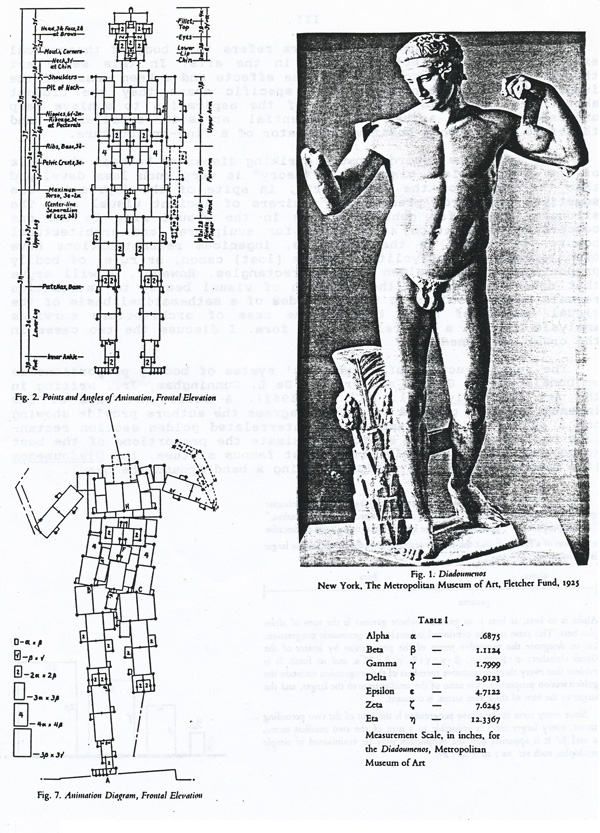
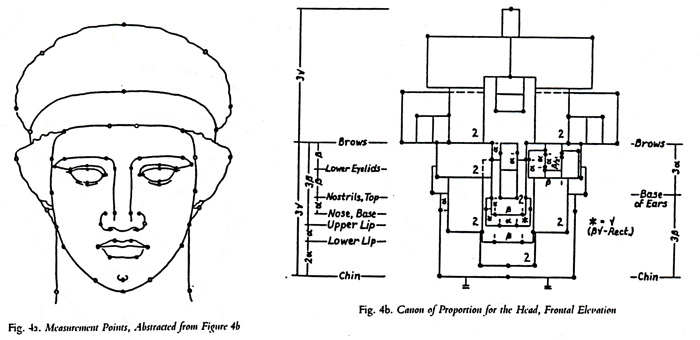
How does one test their conjecture? As philosophers
routinely do, by trying to construct a counter-example. This proves easy
to do, as in the following construction of a face that cannot possibly be
super-beautiful if Polykleitos's face is the acme of
beauty.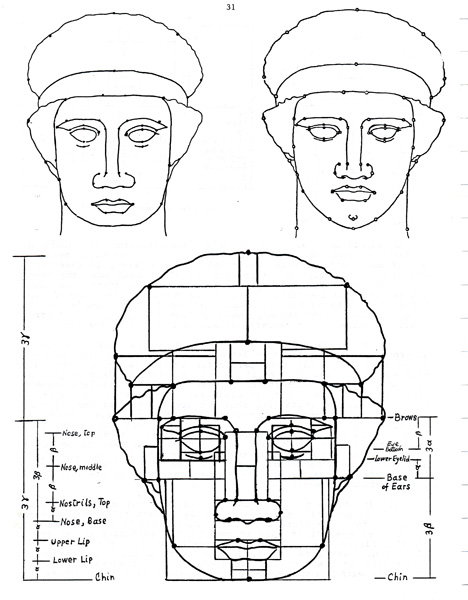
It seems obvious that the authors never thought of this obvious point, as searchers for golden section instantiations in art and nature have seldom if ever done. In this they go one step beyond the method of religious folk who "prove" the benificence of a creator god by citing all the favorable signs and consigning all the unfavorable ones to the maker's inscrutability. The art historians don't even recognize the problem (the problem of aesthetic evil, we might call it).
13. Faces made symmetrical
Here is the Marquardt website's African beauty (version 2) made symmetrical. This is the version with the smaller lips. Study the images to see which is which and then to judge which is more beautiful, and why.
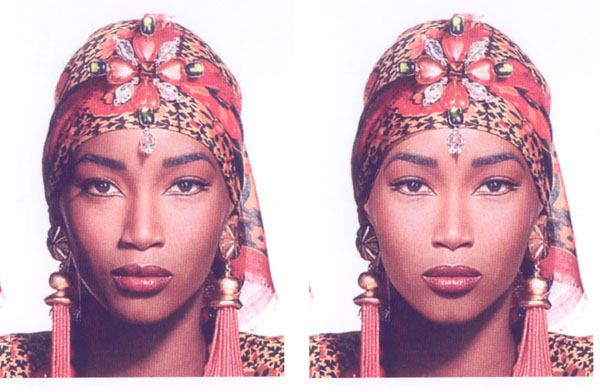
And here is the other version (where the other side of the face is flipped over to produce symmetry):
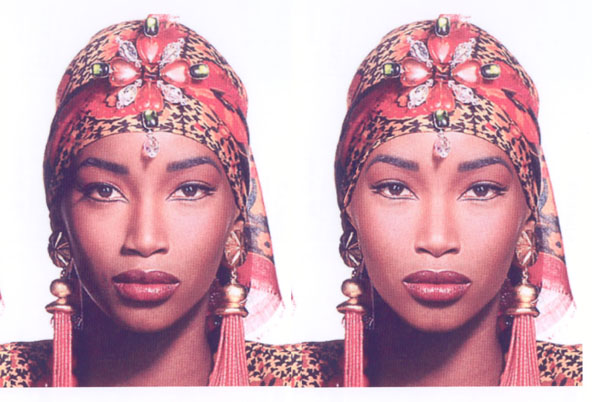
(Note that the transformation by flipping over the one side of the face and superimposing it on the other has produced changes in the width of the nose. The problem is that the axis of the face is slightly tilted and it's hard to align the flipped half with its original. Also, light and shade have been modified.)
14. Thoughts about criteria of beauty of animals
For purposes of discussion I propose several criteria for a beauty scorecard for animal. The card calls for:
- Points for structural beauty and beauty of action
- Points for adaptation to difficult conditions
- Points for adaptation to a wide range of conditions
- Points for structural features suggestive of higher
cognition and feelings
2 is meant to offset somewhat the structural ugliness of (say) bottom-dwelling fish with both eyes on one side. Should the fact that the adaptation is successful ("ingenious," perhaps) balance out some of the beauty-deficit of the structure? Or should the adaptation-value be kept separate from beauty -- that is, not be regarded as a kind of beauty at all?
3 is inspired by the thought that the credit allowed in 2 shouldn't entirely balance the structural deficit because confinement to a small niche is itself an adaptation deficit compared with confinement to a wider niche. So a creature is more beautifully adapted if (other things being equal) it can cope with a wider range of environments. I think we tend to think of adaptation that way. But is it right? I invite your thoughts.
4 is meant to help explain why we regard dogs or horses as more beautiful overall than, say, fish. Fish aren't as intelligent-looking, proud-looking, loving-looking as mammals -- or the mentioned mammals, at least. Of course monkeys and apes would score higher than horses in this category, and that might make us uneasy, since we don't usually regard them as outranking cats and horses overall. But remember that the overall rankings come from combining all the points in the different categories, so our personal favorites might still come out ahead. (See Beauty-adds #10 and items ##15-16z below for contributions on this subject from Jonathan Swift's Gullivers' Travels.)
Again, I invite your thoughts about all of this. The animal world is not an easy domain in which to judge things for overall beauty! (think how hard judgment is regarding insects.)
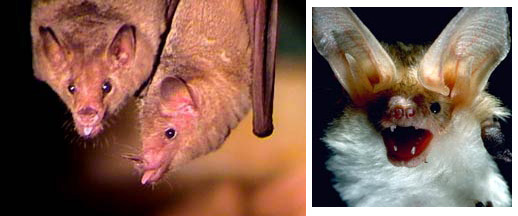
Some images relevant to differential animal beauty: bats as a premier example of unlovely creatures to look at (formally unbeautiful creatures) regardless of how beautifully functional they may be in their ecological niche.
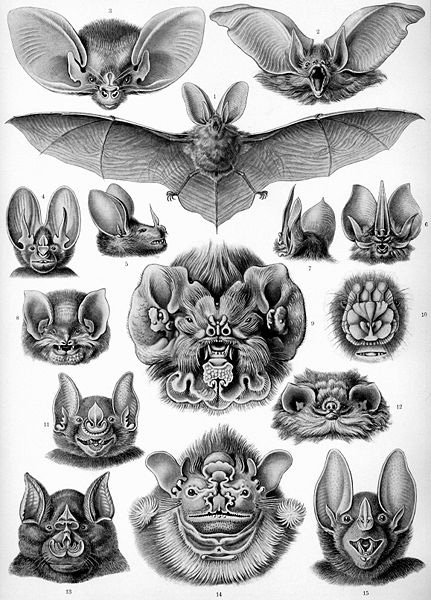
Ernst Haeckel, Kunstformen der Natur (Nature's art forms), 1904.
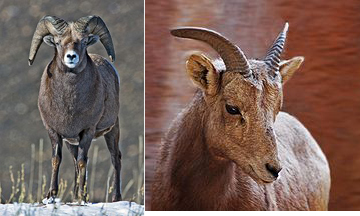
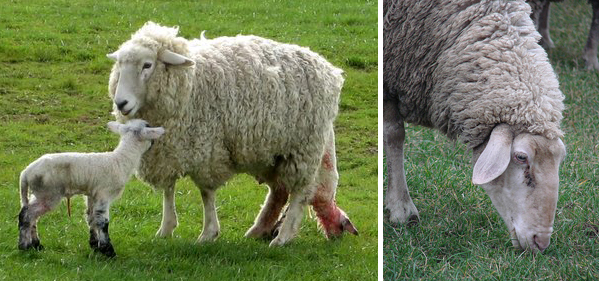
Big Horn and domestic sheep compared: Is one better than the other on updated Aristotelian principles?
15. How beautiful are humans compared with other species? Gulliver's issue addressed, Pt. 1. Refer back to Beauty-additions #10.
Gulliver developed an acute inferiority complex from his experience in the country of the Houyhnhnms. That leads to the question of how we humans compare humans with horses and other nonhuman species in beauty? First consider bodily appearance alone. A moment's reflection will convince us that the question is answerable only if we specify the conditions of the contest. Are we to take humans without clothes? What about grooming, especially the cutting or shaving of hair, of nails or hooves? Are we to judge humans at all ages compared with horses at all ages, or each at its peak of physical beauty? It seems clear that the competitive situation will change radically depending on such choices.
If it is strictly bodily beauty we are judging, clothes would seem inappropriate. So let us suppose we require entire nakedness. That will increase the impact of our choices in the next two variables. Suppose we allow brushing, binding, or braiding of the hair on the head but exclude shaving or removal of hair on other body parts? We also allow nail-paring but no painting or glossing. These stipulations would be matched by limitations on the nonhuman animals in the contest, where applicable. The third question is the most momentous of all. Human bodily beauty, male and female, declines with the middle and elder years more than that of most species. If the beauty of our champions has to be their net beauty over a long life it seems certain that the leading animal species will come out more beautiful overall. It's embarrassing even to dwell on the outcome. Gulliver would be right to feel inferior on this basis.
But there are other, more human-friendly competitions that deserve to be considered. One confines judgment to several beauty peaks, one in childhood, one in adolescence and one in young adulthood. Under these more human-favorable conditions how will our species fare? We cannot draw on the views of the experts because so far as I know no expert literature exists. So I offer you my intuitions, to get the discussion going.
1. Highly beautiful human children of, say, 4 to 9 years, compete evenly
with highly beautiful kittens and win the competition with foals, which are cute but
awkward.
2. Highly beautiful adolescent females compete evenly with highly beautiful
adolescent cats and colts/fillies. The three are all pretty much on a par, I
think.
3. Highly beautiful adolescent males begin to have a problem because of the
growth of their genitalia, which are silly becoming grotesque compared with the
more inboard male genitalia of the other two species.
4. This disadvantage increases markedly in the young adult male human. The
penis is exceptionally large for the size of the body. This may have all sorts
of good effects on culture (see the excerpt on mate selection, Beauty Add-ons
#9) but it does not improve the outward appearance of the male human. Also the
growth of body hair is a considerable beauty deficit, especially in the more
hirsute human ethnicities, as is evident from the pains taken to control or
hide it.
5. Young adult females also suffer from body hair, which is not distributed in
a very attractive way, but the most beautiful females outscore the most
beautiful males in this department, and do so also by a wider margin in respect
to genitalia (not because the female pudenda are more beautiful, but only
because they are not so conspicuous).
Overall, my conclusion is that Gulliver should not be so appalled at the likely outcome of this second competition as at that of the first. Do you agree with that, and with the assessments that went into it? Keep in mind that these are just two of a large number of competitions. It says nothing about the comparative beauty of human movement or emotional responsiveness, or comparative beauty in clothes or other forms of decoration. But it strongly suggests that our claim to beauty does not rest on our merely natural bodily appearance at rest. If we come out ahead overall, it must be because we gain through these other beauty competitions.
16. Gulliver's problem, Pt. 2.
Suppose now that we consider the beauty of humans in respect of mental and emotional responsiveness, which was also a major concern of Gulliver's. What rough sketch will result? Clearly humans are wonderfully responsive in these ways, compared with horses, cats and other animals. They excel in diversity and subtlety. Consider their moral life. It is vastly more sophisticated than that of animals. So the most moral human is more beautifully moral than the most moral animal. However, Gulliver is tortured by the depths of depravity which are an inevitable by-product of the human moral endowment. No animal comes close to humans in the capacity or reality of wickedness. So the outcome of a contest will be very different if we focus on a moral champion than if we judge humans at large compared with animals at large, or moral potentiality compared with moral attainment.
Gulliver's depression was much affected by the endless depravities of people in his home culture (18th century England) compared with the perfectly socialized houyhnhnms. Those horses lived a considerably less complexly cultured life than Europeans did. They lacked the competitiveness for wealth, power and sexual extravagance that are so much a feature of high cultures in our world. Lacking religious feelings they were free of doctrinal and sectarian rancor and violence. Lacking romantic passions they were affectionate to their kind without being desolated by loss. Needless to say this is an idealized picture of horses (even without considering the superior rationality Swift confers on them). So the proper comparison for us to consider is not humans versus houyhnhnms but humans versus horses as they actually are. Even on this basis humans at large come off with a mixed rating, with pluses to be sure but alsowith a lot of demerits, whereas horses have a somewhat narrower range of both (little if anything deserving to be called crime in equine culture, for instance).
Having said this much, I leave the rest of the topic to you. Obviously I have only scratched a tip or two of a very large iceberg.
17. Terms for beauty and its opposite. In the lead-up to lectures 4, 6, and 7 I list terms commonly used for different sorts of beauty and unbeauty. It’s worthwhile repeating the lists here so that we can conveniently add to them when new terms come to mind. Our usage is quite complex especially on the negative side. I use “unbeauty” and “unbeautiful” but these are hardly idiomatic.
17.1. High-value beauty-terms beyond “beauty” and
“beautiful.”
a. Slightly more pointed: lovely, elegant,
gorgeous, good-looking, handsome, stylish, exquisite, harmonious, sublime,
fabulous, glorious, brilliant, radiant…
b. Compounds with well-: well-proportioned, well-balanced,
well-composed, well-shaped, etc.
c. Adverbial compounds: beautifully
clear/bright/sparkling/luminous, beautifully smooth/soft/delicate, beautifully
vivid/fresh/bold, beautifully subtle/precise/intricate,
beautifully regular/coordinated/spaced, and so on ad infinitum.
17.2. Intensifiers of the above
Re. beautiful. very, highly, sublimely, exquisitely, radiantly,
unsurpassingly,
unmatchably,… (in
constructions of the …is beautiful
form)
Re. a. very elegant/good-looking/handsome/stylish/ (not with the others)
Re. b. very well-x. Other intensifiers replace well-: superbly x, perfectly x, exquisitely x, and of course beautifully x …
Re. c. intensifiers selectively replace beautifully, e.g. exquisitely
delicate, superbly bold, perfectly coordinated,… But
many in many cases there is no intensifier.
Very added on top of beautifully is merely redundant.
17.3. Moderators of the above
Re. beautiful. Perhaps somewhat
b and almost b are examples, but
not fully idiomatic. Clearly
idiomatic moderators replace b: pretty,
good-looking, nice-looking,
attractive, cute, sweet, pleasant, neat… We also speak of things having a modest degree of beauty.
Re. a. sort of
elegant/good-looking/handsome/stylish (not with the others)
Re. b. pretty well-x, fairly well-x, reasonably well-x,…
Re. c. Moderators selectively replace beautifully: reasonably
clear, somewhat subtle, fairly regular/precise/vivid.
But the aesthetic value implication of
these is often questionable.
17.4. Terms for the middle range
Re. beautiful. plain, ordinary,
commonplace, unremarkable, middling,
OK, not really bad, average…
Re. a.-c. I don’t think there are any idiomatic counterparts for
the middle range.
17.5. Qualifierers
for the middle range
Intensifiers: very/extremely/utterly plain/ordinary/unremarkable…
The only moderators I can think of are: a bit plain, somewhat ordinary.
17.6. Terms for unbeauty
of various sorts
Note that there is no idiomatic
negative counterpart for beautifully-p. Unbeautifully-p is artificial.
General:
unattractive, grotesque, ugly, hideous,
monstrous...
More
pointed: dowdy, dumpy, frumpy,
kitschy, inelegant, messy, sloppy
Structure:
ill-formed, poorly formed, badly formed, misshapen,
deformed, disproportioned, distorted, distended, lumpish,...
Movement:
awkward, clumsy, ungainly, ungraceful,
sluggish, gawky...
Appearance:
ill-favored, unsightly, peculiar-looking/sounding,
weird-looking/sounding, horrible-looking/sounding, awful-looking…
Intellectual
quality: slow, unintelligent, dense,
stupid, unperceptive, unobservant, insensitive, undiscriminating, illogical,
irrational, unreasonable, confused, thoughtless, bigoted,
prejudiced, narrow-minded, silly...
There are many
more categories and terms. Context considerably affects which terms apply. Note the absence of terms for psychological effect: pleasant, delightful, disgusting, etc. To the extent that these denote mere causal effects without any implication of their being appropriate, they can't designate values of the things that cause them. But if one uses them with the understanding that the delight, say, is justified (that one ought to feel it toward this object), then the term designiates an aesthetic value. Delightful used this way is like desirable in its proper sense of ought to be desired, a positive value term, not just a term of psychological effect.
18. Beauty and goodness
I think there is much to be said for the idea that any sort of goodness at a high enough level should count as beautiful. Admittedly this is a minority view within the community of philosophical aestheticians today. Still, I think it deserves a fair hearing. On the one hand we want to draw distinctions and keep separate things separate. On the other hand we want those distinctions not to obscure real connections. So each distinction needs careful consideration. Consider the case of the moral and the beautiful. How separate are they?
The examples of moral goodness that seem most natural to call beautiful are those that are of unusual moral excellence, such as extraordinary courage under fire, extraordinary dedication to good causes, extraordinary fairness in dealing with friends and adversaries alike, extraordinary kindness to those who deserve it even when it they are unlikeable, and so forth. People who are beautifully moral are those who act above and beyond the call of (ordinary) duty – the term for this is "supererogation." Add to that the excellence of the moral inclinations being so well ingrained as to come naturally, and don't you have a picture of a beautifully moral person? This idea has been put forward by Guy Sircello in A New Theory of Beauty (1975) and I think it has a lot of plausibility. My own further thought about it is that our experience of contemplating such a person (as of acts which flow naturally from such a person) is not ultimately distinguishable from paradigm cases of aesthetic admiration, such as admiring the beautiful faces we have been studying. Both kinds of case involve conspicuous harmonies. Dwelling on them brings us joy if we are not turned off by something like envy or small-mindedness. Think of the pleasure we get from fictional portrayals of authentic supererogation. By "authentic" I mean to exclude the stereotypical cases where the personality is a caricature, not a possible reality.
Just how far this connection goes is a big, big question. The most serious apparent discrepancy between the morally good and the beautiful (or the aesthetic in general) is the rule-governed character of morality. Typically morality aims at compliance with good rules of conduct. Aesthetic goodness, on the other hand, does not seem typically to be a matter of compliance with rules. On the other side, pleasure seems to be more determinative of aesthetic excellence than it is of moral excellence. I do not think we can hope to solve this problem in this course.
19. Cicero's notion of the idea in the artist's mind
Ask yourself to imagine the most beautiful face or horse or anything else. Specifically ask yourself to imagine one more beautiful than any actual instance you have ever seen. Can you do it? Cicero thinks you can and that artists commonly do just that when they are trying to sculpt or paint a perfect paragon of humanity, say. Supposedly they form that idea and paint using it as a guide. I am suspicious of this claim. I think it harbors a conceptual confusion. Of course when we say we have imagined our ideal person we have done something, but is it really to have imagined a person whose face, as imagined, is more beautiful than any we have seen -- even for ourselves? What do you think? It's a topic we must discuss in class.
20. Questions on Plato's theory of beauty: ones we will encounter but not be able to answer definitively.
- Can beauty be defined?
- Is it perhaps a
primitive, not definable at all? Like green?
- Are order, measure,
proportion, etc. sufficient and necessary?
All definitions make use of other terms"bachelor" is defined as an unmarried but
marriageable male. So any definition of beauty must use other terms. Here is
one definition, by G. E. Moore: For a thing to be beautiful is for the admiring
contemplation of that thing to be intrinsically good.
Given the enormous variety of things with some claim to beauty, it is likely
that a definition that covers all of them will be more like Moore's than any
formula concerning order, proportion, symmetry, etc. Those properties are more
likely to be normative criteria (beauty-makers) than parts of a definition, which are internal to the concept.
- Are all beauties commensurable with each other?
If beauty is a single inherent (non-relational) property of things, as Plato seems to believe it is, then there ought to be a single rank-ordering along a single continuum. Everything would be more or less or equally beautiful in relation to everything else. However, it is hard to believe that things are this simple. Many comparisons seem hardly to make sense: that this sunset stands in an exact relation to Mozart's 40th Symphony, for example.
The alternative to full commensurability would seem to be a number of rank-orderings (sunsets in one, symphonies in another, etc). But this leads to the question, what makes all these rank-orderings species of beauty? That propels one into a search for a unifying conception at a higher level.3. Even if beauty is somehow perceptible, need it be analyzable or understandable? Here is a deep and rather baffling question. What does it take to be analyzable or understandable? Is more required than for the beauty-making properties to be identified: the beauty of the whole to be found to vary with these properties?
4. Is moral goodness a species of beauty? Is there any intrinsic connection between beauty and virtue? Another difficult question Plato clearly thinks there is, and many other philosophers do too.
5. Is pleasure connected with beauty merely contingently or somehow necessarily? Clearly the connection is not a simple one since all sorts of pathological pleasures exist. How can we pin-point the relation(s) between beauty and pleasure?
This will be a major issue in the sense of beauty theory that we will take up immediately after Plato.5. Is intellectual pleasure higher, finer, or more beautiful than sensory pleasure? This is a widespread view among Platonists. Something about it seems right. But some social critics say that it is a class-based prejudice. How can one fairly decide the issue?
21. Plato's dialogue Hippias Major, which concerns the definition of beauty.
The one surviving Platonic dialogue that discusses the definition of beauty (or 'fineness') has been downplayed in TOB, relegated to a mere footnote. This is mainly because it is so inconclusive and also because it offers nothing that is not included in the other dialogues. Still, if anyone is curious about it, I recommend that you go to the Wikipedia site for it where there is good summary.
22. Color exhibits re. sense of beauty theory (supplementing Beauty Additions 17). Caution: I have no way of knowing whether your computer will display exactly the same colors. I have had to give up on the projector in the classroom, which ruins them.
22.1 Color spectrum
 22.2 Below, left, jumbled color chips from two nearby hues. On the right, the chips sorted
in their right relations to each other by saturation and lightness.
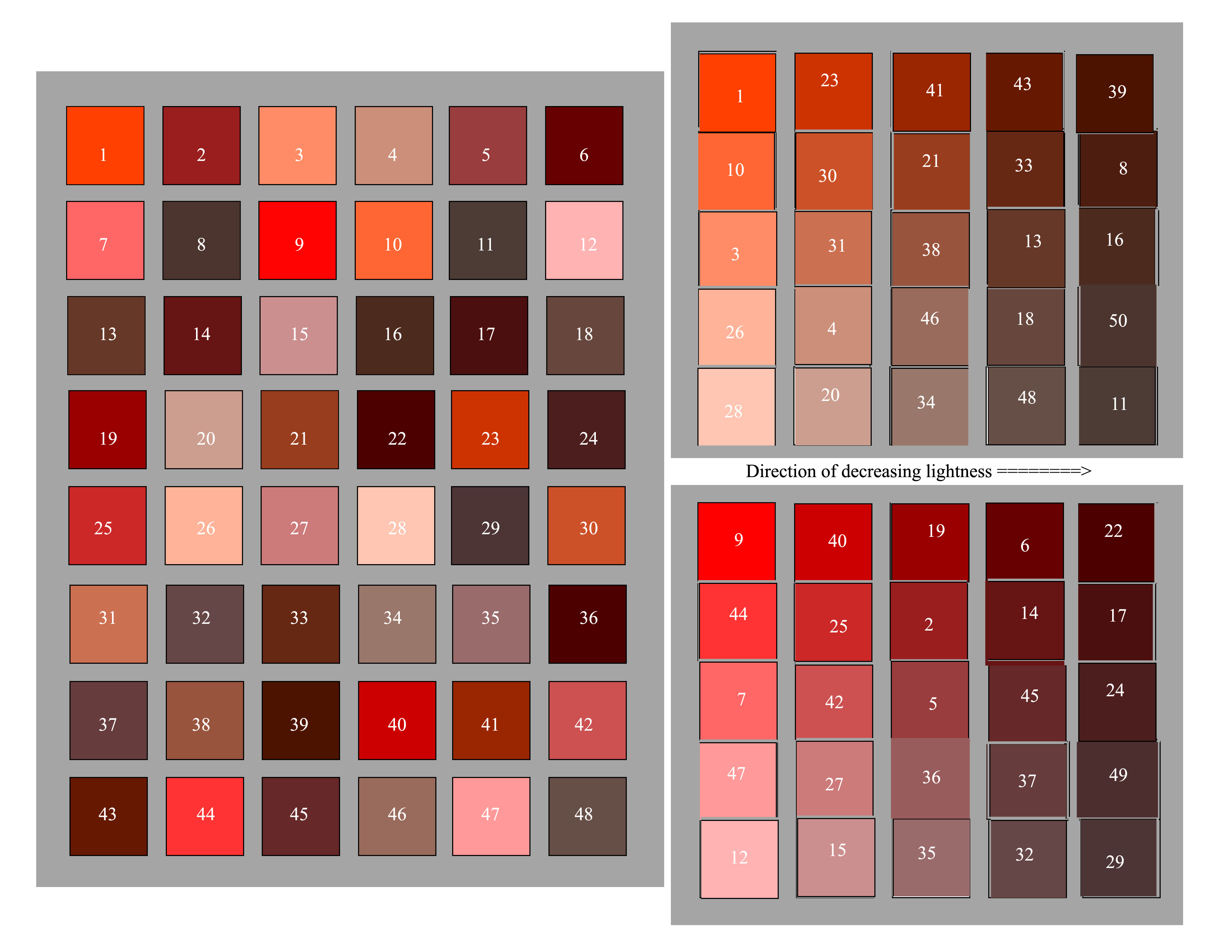
22.3 Full color vision contrasted with anomalous color vision, showing reduction of perceived differences (these are from the website:http://entirelysubjective.com/color-sensation-metamers/).
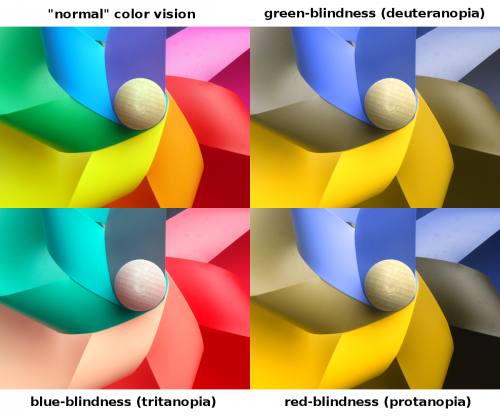
22.4. Top row: an exceptional case where anomalous vision beats normal vision.
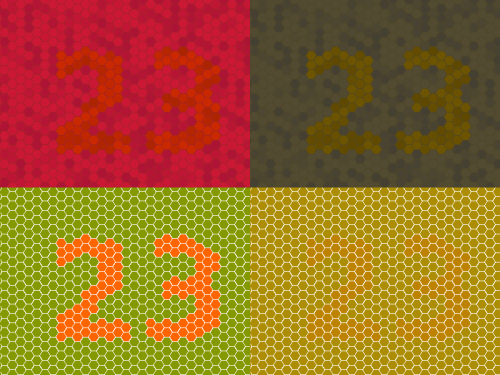
Bottom row: the normal case (as in driver's license tests of color blindness).
22.5 Exhibit showing interaction of colors
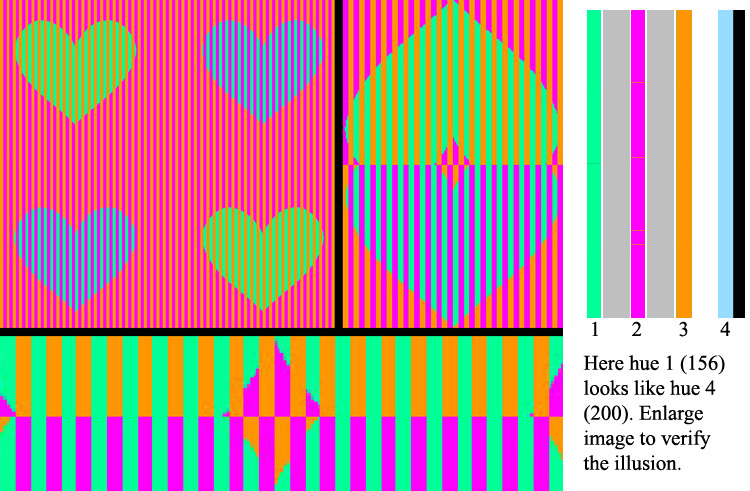
*An interactive exhibit on the interaction of colors is available on the site given in Lecture 9.
*Beauty Additions #17 shows the Munsell color solid.
*A highly instructive series of 1984 BBC videos, "Colorful Notions" is available for anyone with enough time and interest to take them in: http://entirelysubjective.com/color-sensation-metamers/ Needless to say I do not approve of the "entirely subjective" in both the URL and the text of the videos, for reasons I try to make clear in lectures. But the information provided by the program is solid and quite fascinating. The images are fuzzy because it's a copy. The BBC program itself is only available through library CDs, apparently. The series is also available at: http://www.youtube.com/watch?feature=player_embedded&v=4YuEhr-C-8U#!
*Anyone really hooked on color will be delighted by the demonstration on this site: http://www.youtube.com/watch?v=qm9d9qV39Ec&feature=related
22.7 Harmonious and disharmonious colors
22.8 See also Beauty-Additions 17 (Munsell Color solid).
23. Color temperature literal and aesthetic. Colors famously are seen as hot or cool and a number of other things. The first thing to be clear about in the aesthetic appearance of color is not to confuse it, say hotness of certain pinks, with actual temperature as measured scientifically. The real and the aesthetic hotness are in fact almost completely inverted. Here is the scientific story about color temperature. Go to the Wikipedia "color temperature" site for explanation.
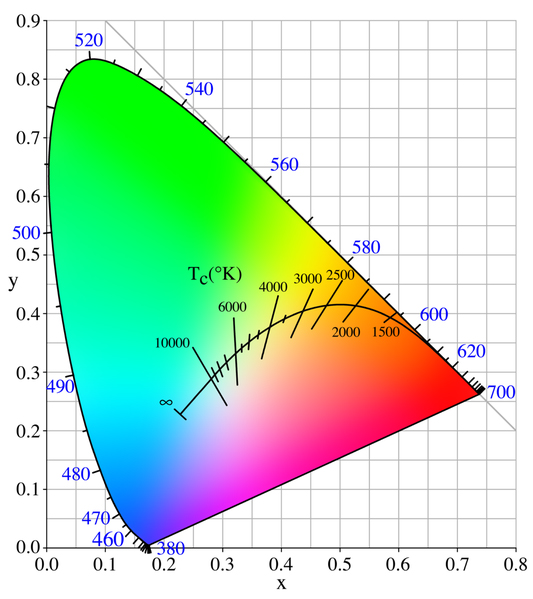
Colors that are hot in aesthetic terms (hot-looking) are physically the coolest, and those that are coolest-looking are physically the hottest. So please, never, never confuse the aesthetic hotness-appearances with physical hotness. Yet the look of colors is virtually universal among fully color-sighted human percipients, so it counts as an intersubjectively valid aesthetic appearance. In the chart above the scale of physical temperature runs from 1000K to 10,000K in the arc across the colors.
24. Synesthesia. Another mistake to avoid is confusing
aesthetic appearances, commonly called "crossmodal"
perceptual effects, with the experiences of synesthesia. Synesthesia is a
deviant condition whereby subjects see things in one modality as having
properties in another without there being any crossmodal resemblance between them. Synesthetic perceptual linkages are in that sense
arbitrary. Synesthetes vary enormously as to the
linkages they experience. Numbers are seen to be colored, often in
"another space," and colors are experienced sonically as well as
visually. Psychologists are busily investigating the neurological factors
producing these illusions. Since they aren't based on crossmodal resemblance they do not play any role in the theory of beauty. The following
diagram illustrates the phenomenon of numeral-color synaesthesia.
Can you instantly find the triangular pattern of numerals in the
display on the left? In a time test you will lose to a synaesthesiac who sees the black and white display in the fashion shown on the right.
Seeing numerals or letters as differentially colored is typical of synaesthesiacs. Their ability to outperform normals in tasks facilitated by illusory color
differentiation is proof of their being synaesthesiacs.
But the differentiated colors they see have an entirely arbitrary relation to
the shapes. Normals are not deficient in being unable
so quickly to discern pattern-differences that depend on such illusions. Hence
there is no reason to confuse synaesthesiac phenomena
with cross-modal resemblances.
Synaesthesia, like color-blindness, obviously will affect the aesthetic experience of those who suffer from it. But this fact in no way challenges the objectivity of aesthetic value.
25. Color symbolism. A third caution about aesthetic
properties is this. There are many entirely speculative claims about associations
between colors and other properties that are culturally dependent, not stemming
directly from the character of the properties
themselves. For example a website on colors gives out the following wisdom:
http://www.color-wheel-pro.com/color-meaning.html
"Blue is the color of the sky and sea. It is often associated with depth and stability. It symbolizes trust, loyalty, wisdom, confidence, intelligence, faith, truth, and heaven...In heraldry, blue is used to symbolize piety and sincerity."
There is likely some faint and indirect connection of some of these symbolic meanings with aesthetic properties of the colors, but for the most part the symbolism is arbitrary and certainly not intersubjectively universal.
26. Diagram of the dispositional concept of color.
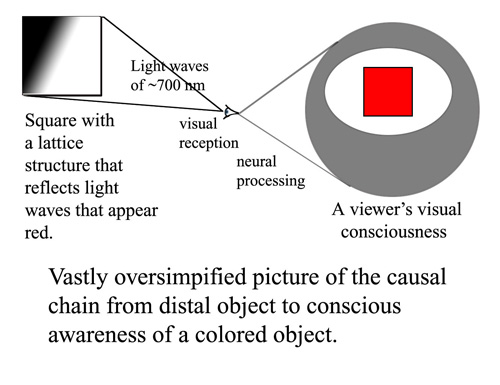
27. Diagram of the dispositional concept of beauty.
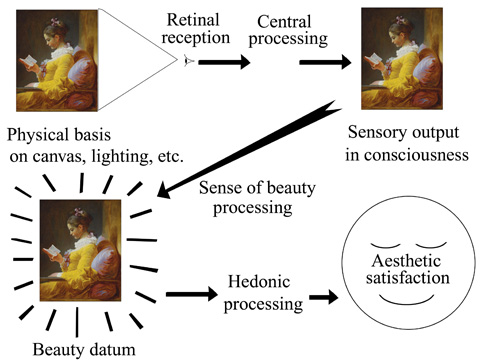
28. What properties do properties have? The example of color.
A given
shade of green, say, will not itself be green (it won't be self-exemplifying)
but it will have plenty of properties. It will be related by degrees of
similarity to the other colors. It is more similar to blue and yellow than it
is to red. It will be complementary to a certain shade of red, and will be
either central green or off-center to the blue or yellow side. It is also tri-dimensional,
the three dimensions being hue, saturation and lightness. This and more may
safely be said about that shade of green as a property. But it is
necessary to stick to what applies to the property in contrast to what applies
to its instances (grass, say). That poses a problem for Plato.
29. Color and its complications. How do we know all
normally color-sighted people have the same color experiences?
1. The Wikipedia article on the Munsell Color System
contains the three diagrams displayed in class. These are
also displayed in Beauty-Additions #17. A site for the color interaction file
shown in class is given in the syllabus+lecture file
for Lecture 11.
2. Here are thoughts about the problem of indiscernible variations in the color experiences of persons, which come up whenever philosophers discuss the status of color as a property in the world.
Some critics claim that in principle we could have infinitely various color experiences proceeding around the hues as long as all the relations within each person's color-space tallied with everyone else's, and we could never tell the difference. Is this really possible? Is that a coherent scenario?
What about central red, blue, etc. vs. mixed color qualia? If what was for me a central red was for you an orange, we would immediately tell the difference. One and the same color-stimulus would be pure for one of us, mixed for the other. That would immediately reveal the disparity in our experience. To avoid this our color-spaces would have to be coordinated pure to pure, mixed to mixed.
Another question is whether the space between the pures is uniform. I don't know the answer, but if there are more red-toned mixtures than there are yellow-toned ones, there would be another tip-off when we spread out our experiences.
Another question concerns the tonal range of the different hues. Blue is inherently less bright than yellow. So the two hue-ranges can't be switched without there being evidence of the difference.
Finally, there are the associated qualities, especially hotness values. Red is inherently warmer than green, for instance. See the chart of color temperature in #23 above.]]
HOWEVER, even if there could (in principle) be entirely undiscoverable variations in our color experiences, all that the intersubjectivity thesis about color assumes is that the best explanation of our color experience is that the appearance of uniformity is due to the fact of uniformity. The in-principle skeptical possibility is no more a problem here than it is for any other empirical belief. In principle it is possible that the world came into existence five minutes ago and all our memories are an illusion. That doesn't keep it from being objectively true that the world was created billions of years ago.
So I persist in thinking that if beauty could be explained in terms of a sense-like faculty that is as reliable as color-vision is, beauty would be rightly considered a real (intersubjectively real) property of the world.
30. More on descriptive aesthetic properties: the Kikki-Bubba, Ping-Pong and Mil-Mal crossmodal resemblances (shown in class ppt. presentation).
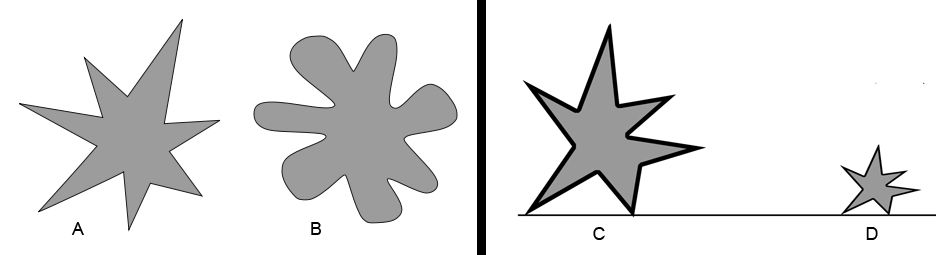
Which of A and B is Kikki?
Which is Bubba? Which is Ping? Which is Pong?
Which of C and D is Mil? Which is Mal?
Have we any difficulty whatever saying?
31. Functional beauty. Two paragons of high functionality and therefore of functional beauty.
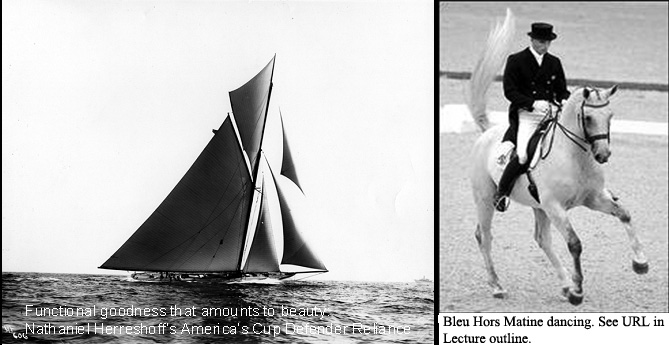
32. Simple beauty, several examples.
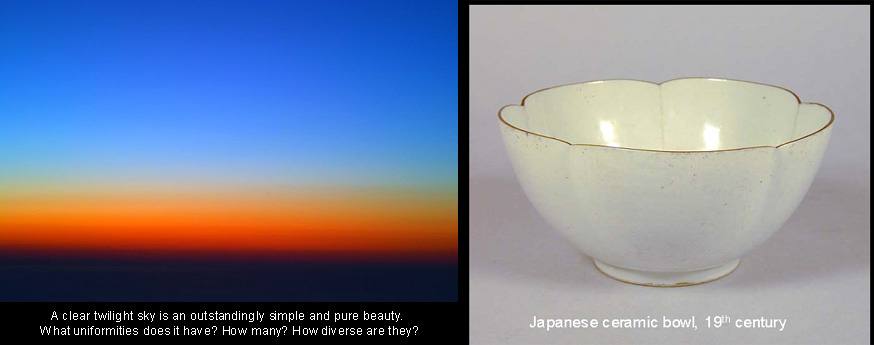
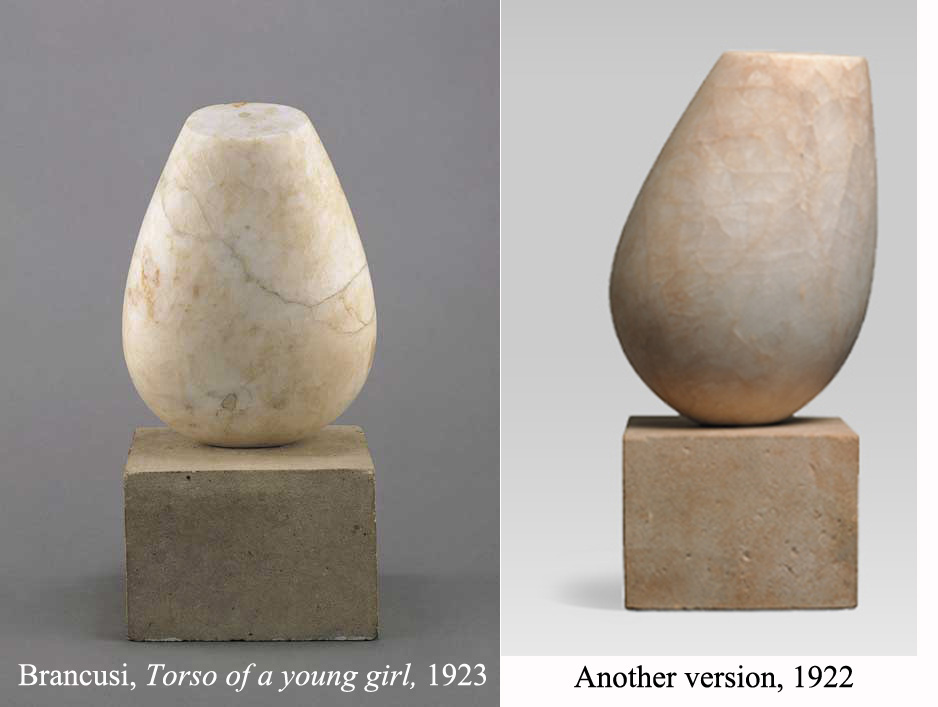
33. Natural beauty.
(a)
Trees considered venerable are often not highly beautiful, as in the case of the 1000-year-old Major Oak. The artist's rendering of a mighty oak gives it attractively gestural properties and finesses the matter of leaves.
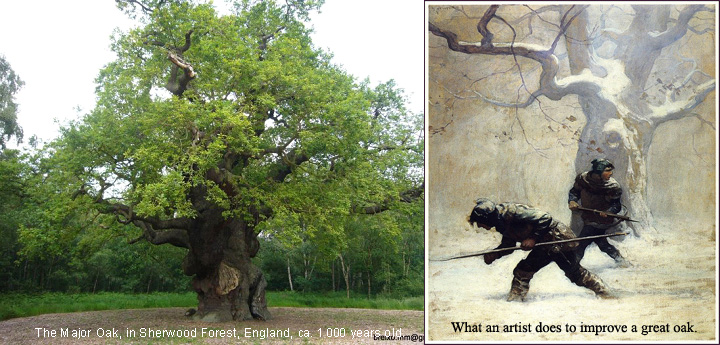
(b) Is symmetry better than asymmetry? Does making the Japanese maple shown below more symmetrical make it more beautiful? Or does it make the tree seem slightly artificial? Perhaps the irregularity suggests more inner vitality.
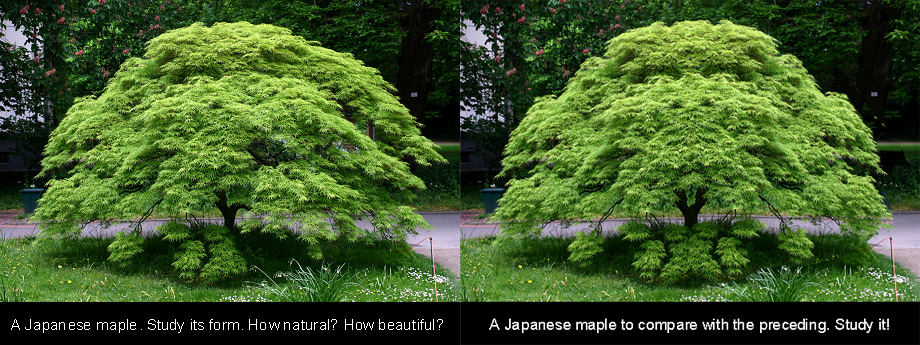
34. Strange case of beautiful mutilated sculpture. Would they be more beautiful if unmutilated? Two examples.
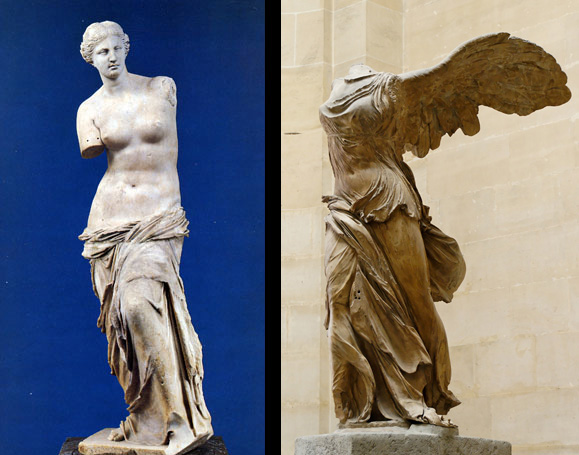
On the one hand it would be unreasonble not to want to see what the sculptor produced in full. On the other hand, the mutilated remainder in these cases is very beautiful. We respond to it the way we do to works of recent art that abstract away from the full figure -- the Brancusi torso or the following famous Rodin bronze, Walking Man, 1877-78.
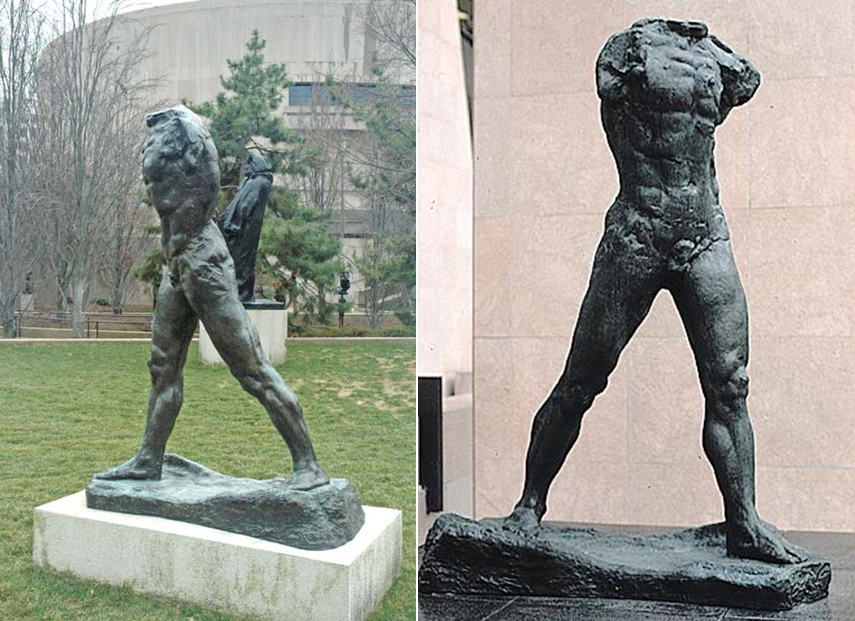
As the Rodin piece shows, we can value a sculpture of a part in abstraction from the full body. This point is obvious from the Brancusi example given previously. Yet clearly not just any abstraction would be good, or any mutilation either. Some would ruin the work. Sculpted faces whose noses have been knocked off, for example.
35. A sense of beauty essential:
On the sense of beauty theory beauty is defined in terms of a reliable sense, hence a consensus of optimal respondents under optimal conditions is an essential condition of beauty existing. This consequence breaks down into a number of parts, formulated in terms of beauty questions:
1. If there is never a consensus among those meeting Hume’s optimizing conditions, even when operating under ideal circumstances, about any beauty question, then there is no reason to believe there is real beauty.
2. If there is a consensus under optimal conditions for a restricted class of beauty questions (e.g. easy beauties and unbeauties) then that part of the beauty ranking is real enough.
3. For beauty questions on which no consensus under optimal conditions exists, the candidates for a given rank are reasonably judged on a level.
4. We can conceive abstractly of creatures who meet higher optimizing conditions than the best humans do reaching a consensus and thus satisfying the sense of beauty idea, and coming to different rank-ordering than ours. But absent some reason to think that the possibility is real, this gives no reason for doubt about our best beauty judgments. It is more plausible to expect any such super-ideal judges to just make finer distinctions than we can.
This is a further development of the ideas put forward by Hutcheson and Hume. They never pursued the topic far enough to reach this point.
36. Sense of beauty criteria of accuracy: three levels
A beauty-perception is accurate if and only if it represents the following:
1. Agreement with the consensus of maximal discriminators of sensory properties (or of non-sensory ones re. math et al) of the object, operating under optimal conditions;
2. Given 1, agreement with the consensus of maximal discriminators of aesthetic properties of the kind relevant to the object;
3. Given 1 and 2, agreement with the consensus of maximal discriminators of (nondefective) aesthetic pleasure or satisfaction derived from the aesthetic properties of the object.
Note that by "object" is meant anything perceived as beautiful (or unbeautiful), whether a single object (or event) or a part, aspect, or stage of a whole object. "Object" in this sense applies to things of any magnitude, a phrase in a poem, the whole poem, the poet's whole body of work, the entire earth, the solar system, etc. It can also apply to mental states and to appearances of things.
37. Ideal vs. ordinary aesthetic appreciation and judgment
Ordinary aesthetic appreciation and judgment don't have to meet super-high standards to be substantially right. Instead,
1. They only have to be approximately the same as those of the (more nearly) ideal judges.
2. I.e. they don’t have to be highly reliable, only approximately right.
3. They needn’t be fully conscious of the basis of their response. Typically they aren't.
4. They generally are responsive only to some of the beautiful properties of the object, not to all of them.
5. The intensity of their aesthetic pleasure may be just as great or even greater than that of the ideal judges.
For most persons being absolutely right is not a high priority, as they would freely admit. This is as it should be. It's enough that they not be seriously wrong.
The reason for the sense of beauty dwelling upon optimizing criteria of accuracy is that these enter into the definition of beauty. Thus they have to be highly reliable.
38. Scruton on truth, goodness, and beauty further analyzed.
Scruton’s formulations don’t always bring out the complications in the relations among these three.
1. Beauty is an intrinsic value, whether or not it is an inherent property, as opposed to a response-dependent one. It is important not to conflate those two ideas:
<Intrinsic vs. instrumental [value]> and <Inherent vs. relational: esp. response-dependent [property]>
2. Beautiful but not true and beautiful but not good are both possible where the beautiful thing has propositional content (poem, play, novel, or designated portrait or landscape). There is no contradiction in these contrasts.
3. Pursuit of beauty, truth, or goodness is quite different from the existence of the same. Similarly enjoyment of the same is logically independent of existence.
Similarly belief in the beauty of the content of a proposition differs from belief in its truth.
Similarly belief in the moral goodness of an action or person differs from belief in its beauty.
4. a. Rationality requires us to believe what we have reason to believe is true (not just what is true).
b. Similarly rationality requires us to desire what we have reason to think good (not just what is good.)
c. Similarly rationality requires us to enjoy what we have reason to think beautiful (not just what is so).
c’. Rationality only requires us to hope that what we enjoy is beautiful.
“ “ “ “ “ “ “ “ not unbeautiful.
5. Optimistic rationalism (optimistic about our cognitive powers) will hold that in the main these contrasts can be resolved. Thus in the main:
d. Cognitive rationalism requires us in the main to believe the true (in accordance with our reason for belief).
Even if d is true, to get the same brief principle for goodness we must adopt a stronger rationalism, one that supposes dedication to goodness. Then:
e. Good will rationalism requires us in the main to pursue the good…
Even assuming the preceding, to get an aesthetic counterpart we must suppose beauty-perceptiveness and beauty-preference. Then:
f. Aesthetic rationalism requires us in the main to enjoy the beautiful.
The above is as close to Scruton’s simple principles of rationality (Beauty is a reason for enjoying a thing, etc.) as we can get.
Scruton is also concerned about cross-over cases in which aesthetic attraction leads one into moral or intellectual error, or where concern for the good does the same – or the other way around, in which an intellectual concern leads to an aesthetic or moral error. Those cases don’t invalidate any of the above principles of rationality.
39. URLs for Scruton, Ch. 1. The URLs for the items listed by name only are given in the lecture outlines or are found on Wikipedia for the name given.
Bernini, St. Teresa in ecstasy: http://www.artchive.com/artchive/B/bernini/teresa.jpg.html
Enlarge using the zoom icon.
Porcelain figures (German, 18th and 19th century: http://www.christies.com/lotfinder/ZoomImage.aspx?image=/lotfinderimages/d54147/d5414700&IntObjectID=5414700 Enlarge.
Louis Sullivan “Form follows function”: http://en.wikipedia.org/wiki/Louis_Sullivan The Guarantee Building in Buffalo and the decorative frieze on the Wainwright Building in St. Louise are relevant.
Walter Gropius' Bauhaus complex at Dessau is the extreme of modernist privileging of function
Le Corbusier's Villa Savoye is another paradigm..
Sancta Sophia: http://en.wikipedia.org/wiki/File:%C4%B0stanbul-Ayasofya.JPG
The Alhambra, classic case of beautiful architecture.
Orlando di Lasso, Motet for eight voices.
Bela Bartok, The Miraculous Mandarin.
Gabriel Faure, Requiem: In paradisum; and Pavane: http://www.youtube.com/watch?v=Jw8PurepHxk&feature=related


40. Explanation of Scruton re. disinterested pleasure being "intentional pleasure," and a proposed alternative.
Background: “Intentionality” refers to the content of a mental state. Diogenes looked for an honest man. But this doesn’t imply there was an honest man.
*Similarly believing the world will end tomorrow doesn’t entail that the world will end
then (or ever).
*These contents of thought don’t have to be real for the thought (or mental state) to occur.
They are only “intentional.”
Scruton's application: Scruton says disinterested pleasure differs from simple sensory pleasure in having intentional content. This would make intentionality a distinguishing feature of disinterested pleasure.
However, I doubt intentionality can be what distinguishes disinterested from interested pleasure. For me the key differentia is whether the pleasure in taken in the person profiting somehow from the object. It can't be that interested pleasure has no intentional content, since being pleased by winning the lottery certainly has the content 'I won the lottery.' I can have that pleasure even if I'm mistaken and I didn't win the lottery. So that interested pleasure certainly has intentional content. And in fact Scruton and others seem to have something else in mind, namely that aesthetic pleasure is taken in the thing that pleases having aesthetic properties. So it seems that it's really the particular intentional content that matters when the chips are down.
As to whether a seemingly simple sensory pleasure, e.g. the pleasure of a hot bath, is aesthetic or not depends, I think, on whether the pleasure is taken partly in a cross-modal resemblance, e.g. the bath being experienced as “friendly,” “cordial,” “kindly,” “ministering to my needs.” People don't consciously think of much of their sensory pleasure this way. But baths do offer possibilities of aesthetic pleasure (of a middling grade, at least) and probably a lot more such pleasure is preconsciously experienced as aesthetically enriched. In any case my notion of disinterested pleasure doesn't rule out simple sensory pleasure from being disinterested. It keeps it from being aesthetic only if it's not taken in descriptive aesthetic properties.
41.
URLs for the visuals presented in class re. Chs. 2 and 7. This should help people make use of the visuals as they work out their ideas regarding Scruton and plan their term papers. Where no URL is given look up the name on Google and select the Wikipedia entry, which you will find contains the illustration.
Arnold Newman, Georgia O'Keeffe:http://www.carearts.org/lessons/image-bank/a-g1/georgia-o-keeffe-ghost-ranch-new-mexico.html
Arnold Newman, Georges Braque: http://lumieregallery.net/exhibitions_wp/Newman_Achievement_h/index_4.html
David, Death of Marat
Stalin's body: http://www.life.com/gallery/60051/image/2628478/photos-of-the-dead-famous-corpses#index/9
Karsh, Churchill
Trumbull, George Washington before the battle of Trenton
Simoni Martini, Annunciation
Titian's Venus of Urbino
(Boucher) Marie-Louise O'Murphy
Boucher, Toilette of Venus
Boucher, Triumph of Venus: http://www.google.com/imgres?imgurl=http://www.museumsyndicate.com/images/1/6596.jpg&imgrefurl=http://www.museumsyndicate.com/item.php%3Fitem%3D6596&h=800&w=572&sz=144&tbnid=ym-HcTuKIBRXgM:&tbnh=90&tbnw=64&prev=/search%3Fq%3Dboucher%2Btriumph%2Bof%2Bvenus%26tbm%3Disch%26tbo%3Du&zoom=1&q=boucher+triumph+of+venus&docid=EuZAxNwTQyTMFM&hl=en&sa=X&ei=iEy1TrLzH8fi2AWfwp3ODQ&sqi=2&ved=0CDkQ9QEwBA&dur=7271 Japanese Shunga prints. http://www.fujiarts.com/cgi-bin/itemlist.pl?category=Shunga&gclid=CNO5svbSvbMCFcRU4Aodg2kAog
Paul Avril, pornographic illustrations.
Petty girl images (if not the one I showed): http://www.americanartarchives.com/petty,g.htm
Courbet, Sleep
Courbet, L'origine du monde (this is the one I thought too hot -- some would say too gross -- to show in class)
Botticelli, Birth of Venus
Botticelli, Primavera
Rembrandt, Susanna and the elders: choose the1647 version.
Manet Olympia
Philippe Halsman, Marilyn Monroe
Arnold Newman, Marilyn Monroe: http://www.artnet.com/artwork/425847766/425589741/arnold-newman-marilyn-monroe-beverly-hills-ca-1962.html

42. URLs for Scruton, Ch. 3. Same as above re. URLs not given here.
Photograph of savannah in Venezuela. Discussion file #58.
Mona Lisa
Song Dynasty landscape: http://www.metmuseum.org/toah/works-of-art/1973.120.1
Claude Lorraine
J.M.W. Turner Tintern Abbey
http://en.wikipedia.org/wiki/File:Turner_Tintern1.jpg
J.M.W. Turner Shipwreck: http://en.wikipedia.org/wiki/File:Shipwreck_turner.jpg
Thomas Rowlandson (Dr. Syntax): http://www.all-art.org/collections/26.htm
John Constable: http://www.nga.gov/fcgi-bin/timage_f?object=1147&image=2130&c=gg57
Salgado iceberg: http://www.artnet.com/artwork/425373251/iceberg-between-paulet-island-and-the-shetland-islands.html
Salgado desert: http://www.peterfetterman.com/exhibitions/sebastio-salgado-project-room/ (This isn't the one shown in class, but it makes the same point.)
Additional landscapes in England under "Chiltern Hills" and "Haddon Hall, Derbyshire"


43. URLs for Scruton, Ch.4, Everyday Beauty.
English landscape gardens, French formal gardens Wikipedia sites.
Dublin doorways: http://www.panoramio.com/photo/60442291
Japanese temple doorway: http://en.wikipedia.org/wiki/File:Sumiyoshi_Taisha3.jpg
The joint: http://www.daikudojo.org/Archive/wood_joinery/misc_joinery/
A good woodworking site: http://www.nakashimawoodworker.com/
Mudhif reed architecture: Wikipedia "mudhif"
Yoshinogara dwellings: Wikipedia
John Townsend bureau: Wikipedia Metropolitan Museum John Townsend bureau
Ng's Maloof-inspired chair: http://wnwoodworkingschool.com/maloof-inspired-rocking-chair-class-with-william-ng-122112-12812/
Fashions: sites under "saggy pants," "bumsters," "street wear"

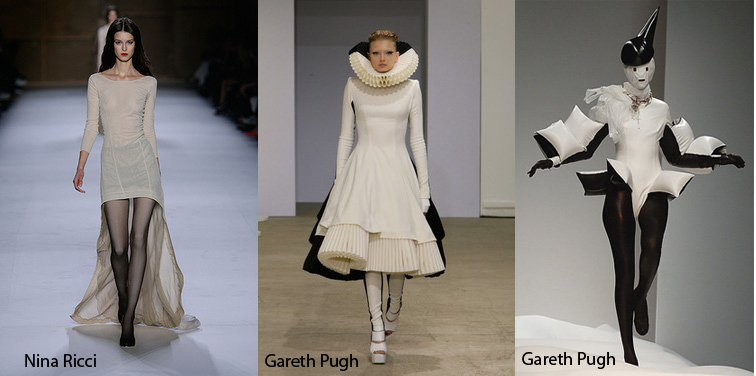
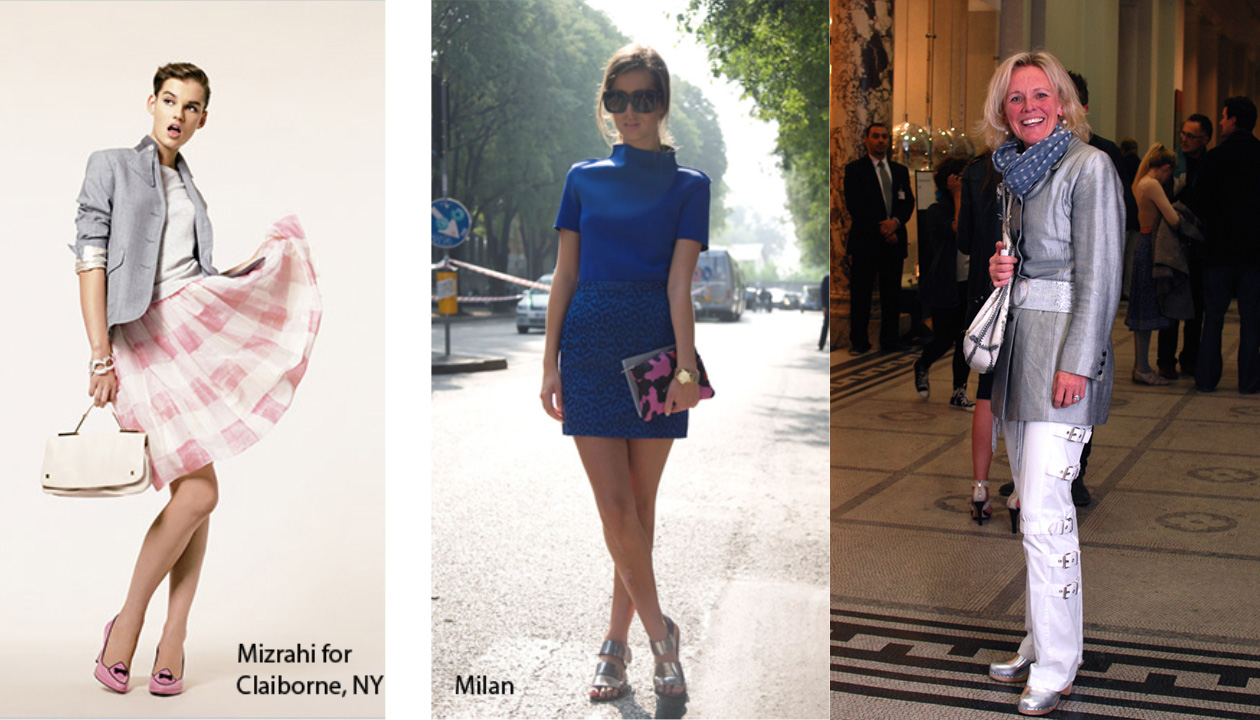
Ewardian ladies' fashions: the Spencer sisters. Are these outfits as beautiful now as they were in 1902? (Trick question!)
44. URLs for visuals re. Ch.5. Ditto the preceding rules.
Duchamp "Fountain" and "Nude descending..." by name on the web.
Lichtenstein's wit: image below.
Schwitter's Ursonate: see syllabus.
Van Gogh's chair. Plenty of images on the web.
Chardin's kettle: http://www.akg-prints.com/en/products/382
Zuburan still life: http://upload.wikimedia.org/wikipedia/commons/e/e3/Francisco_de_Zurbar%C3%A1n_-_Still-life_with_Lemons%2C_Oranges_and_Rose_-_WGA26062.jpg
Fantin-Latour still life: Wiki article by artist's name.
Millet's gleaners: Wiki article by that name
Bouguereau articles on internet for the images of his work. Start with Wikipedia by his name.
"Anselm Adams winter sunrise" by that name; Dawn, Mt. Whitney, Sierra Nevada, California 1932 ditto.
Gursky, Andreas. http://www.telegraph.co.uk/culture/art/8884829/Why-is-Andreas-Gurskys-Rhine-II-the-most-expensive-photograph.html
Kiefer, Anselm. http://www.metmuseum.org/toah/hd/kief/hd_kief.htm#slideshow13
Rothko, Mark
Several videos re. Cirque du Soleil and dance in general on Lecture Outline 23.
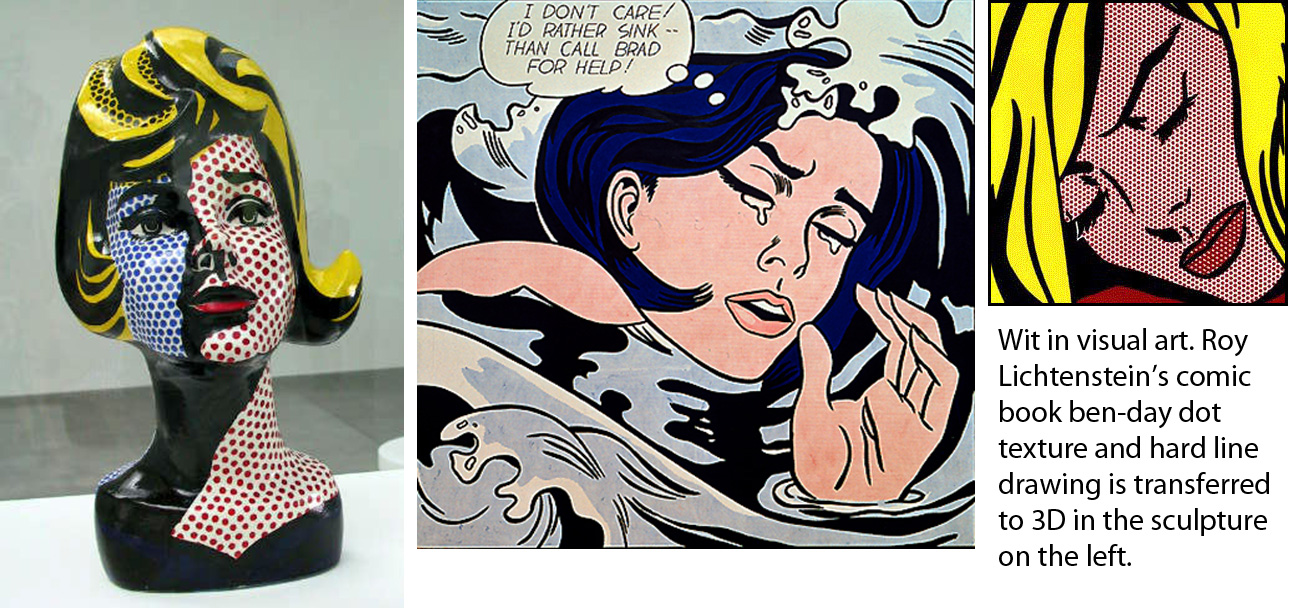
45. URLs for Ch. 6 (Google where no specific URL is given; Wikipedia usually)
Botticelli spatial analysis: See article on my home page "Getting deeper into pictures..."
Whistler nocturne: http://www.artgallery.nsw.gov.au/work/8041/
Whistler, Nocturne in Grey and Gold, Westminster Bridge
Whistler: Black Lion Wharf. 1859. Etching
Whistler: Harmony in Pink and in Grey: Portrait of Lady Meux
Whistler: Zaandam: the Netherlands, etching
Whistler, Nocturne: The River at Battersea, lithotint
Rembrandt, The Mill
Turner: Staffa, Fingal's Cave
Michelangelo, Laurentian Library vestibule
Michelangelo S. Lorenzo facade model: http://architecturalwatercolors.blogspot.com/2011/08/noli-me-tangere-rebuilding.html
Giuliano Sangallo, http://www.all-art.org/history230-7-1.html
Raphael as architect http://www.studio-international.co.uk/architecture/raphael_4_1_05.asp
Nashville Parthenon
Giovanni Bellini, San Zaccaria altarpiece
46. URLs for Scruton Chs 8ff. Same rules as before. Googling as a default.
Bouguereau Nymphs and Satyr (Google)
Kitsch images: Wikipedia articles "Kitsch," "Vladimir Tretchikoff."
Greuze http://www.pubhist.com/person/1306/jean-baptiste-greuze
David, Oath of the Horatii
Hindu painting
Brian Donnelly's realist paintings: http://www.briandonnelly.org/#19
Egyptian gods Thoth and Horus
Richard Estes' photorealistic painting: http://images.google.com/search?hl=en&q=richard+estes&biw=1024&bih=673&sei=4MfAUIG0JseDyAG36YCIAQ&tbm=isch ; Dax Norman: http://daxnorman.com/
Lichtenstein comic-derived paintings, e.g. Whaam!: Wiki. Also see images above under Ch. 5
Leger, Les Plongeurs (The Divers): http://www.artknowledgenews.com/Fernand_Leger_Retrospective.html
Kandinsky, Improvisation VI
Spiegelman, Maus, a survivor's tale: Google Maus images.
Damien Hirst, Wikipedia and Self-Portrait: http://mocoloco.com/art/archives/013461.php
Brian Donnelly, Self-Portrait: same site as preceding.
Kaws' SpongeBob and other comic motif images :http://www.kawsone.com/blog For SpongeBob:
http://blog.honeyee.com/kaws/upload/KAWSBOB%20ENTERS%20THE%20STRANGE%20FORREST%20low.jpg Google KAWS The Silent City.
Another artistic use of comic-type images of a non-popular sort by Jean Dubuffet is the L'Hourloupe series illustrated and discussed at: http://www.dubuffetfondation.com/hourloupe_ang.htm I didn't exhibit or mention this but it provides another point of reference in considering Kaws' Silent City.

47. On love: lessons we can learn from Charlotte Brontë's Jane Eyre
I hope some of you have read Brontë's signature novel. Even if you haven't I think you can form a pretty good idea of the emotions the author describes. As Jane falls in love with Mr Rochester a number of feelings and circumstances connect with our reflections about love. Here is a passage from Ch. 17 that begins with the obnoxious commonplace about beauty that this course undertakes to challenge:
Most true it is that ‘beauty is in the eye of the gazer.' My master's colourless, olive face, square massive brow, firm, grim mouth – All energy, decision, will – were not beautiful, according to rule; but they were more than beautiful to me: they were full of an interest, an influence that quite mastered me – that took my feelings from my own power and fettered them in his. I had not intended to love him: the reader knows I had wrought hard to extirpate from my soul the germs of love there detected; and now, at the first renewed view of him, they spontaneously revived, green and strong! He made me love him without looking at me.
[Most observers] would pronounce Mr Rochester at once harsh-featured and melancholy-looking…[but]…I saw Mr Rochester smile: his stern features softened; his eye grew both brilliant and gentle, its ray both searching and sweet…I feel akin to him – I understand the language of his countenance and movements: though rank and wealth sever us widely, I have something in my brain and heart, in my blood and nerves, that assimilates me mentally to him…Every good, true, vigorous feeling I have gathers impulsively round him…while I breathe and think I must love him.
And later, in Ch. 18 we find a passage concerning love's blindness to faults. Jane observes Rochester talking to a young woman of fashion who is trying to charm him.
…I was growing very lenient to my master: I was forgetting all his faults, for which I had once kept a sharp look-out. It had formerly been my endeavour to study all sides of his character: to take the bad with the good: and from the just weighing of both, to form an equitable judgement. Now I saw no bad. The sarcasm that had repelled, the harshness that had startled me once, were only like keen condiments in a choice dish: their presence was pungent, but their absence would be felt as comparatively insipid. And as for the vague something – was it a sinister or a sorrowful, a designing or a desponding expression? – that opened upon a careful observer, now and then, in his eye, and closed again before one could fathom the strange depth partially disclosed; that something which used to make me fear and shrink, as if I had been wandering among volcanic-looking hills, and had suddenly felt the ground quiver, and seen it gape: that something, I, at intervals, beheld still: and with a throbbing heart, but not with palsied nerves. Instead of wishing to shun, I longed only to dare – to divine it; and I thought Miss Ingram happy, because one day she might look into the abyss at her leisure, explore its secrets and analyse their nature.
Fortunately for Jane, Rochester sees through Miss Ingram and ends up with the one who really loves him. Perhaps Rochester in his prime looked something like Beethoven. Let's hope he looked more like the figure at the left than the one on the right.
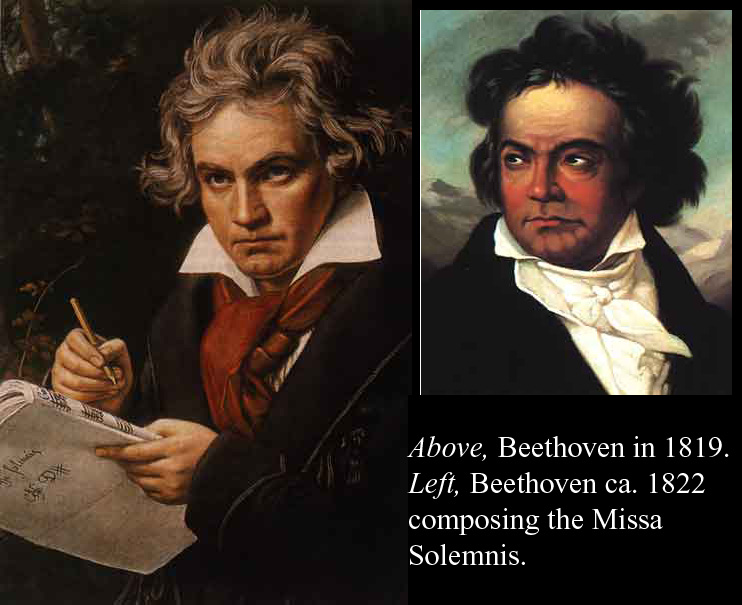
48. Commentary on Jane Eyre's description of Rochester.
1. Rochester does not have beautiful facial features. But his features are well unified under a common property. They go together. To that extent they have some beauty. Further and more importantly, Rochester 's facial expressions have considerable beauty: some are commanding (beautifully masterful, energetic, even vivacious) and others are beautifully soft and gentle. They are governed by intelligence and human understanding. In the context of life, they have considerable merit. For the rest, Jane's own character is such that they suit her. His and hers make a beautiful match . Being with him will make her more beautiful. These are no small aesthetic merits.
2. This passage points up essential features of love, especially the distinction between the beauty a person possesses and the way that person is perceived through the eyes of love. Jane's inner state is divided between these two. On the one hand, the love aroused by the attractive qualities causes her not to notice the defects. But also, the context of Rochester 's whole personality and behavior shows some of the initially repellent features and manners to be better than they first seemed, in fact to be in some way beautiful. She says they are beautifully “pungent,” which implies liveliness, energy, keenness of thought, candor. This gives him a richer character than is possessed by the milder, more decorous species of conventional beauty. There is no reason not to call Rochester 's character beautifully rich, a beautiful mixture of forcefulness and gentleness. But though his character is in this way beautiful, his facial features are still not beautiful and some of his behavior or character may be unbeautiful.
3. Regarding Jane's last reflection about Rochester 's interesting mysteriousness, we need not take it to be a beauty-claim about him but only a claim about his being fascinating to her. Yet perhaps there is something beautiful that attracts her in his mysteriousness, namely the adventure she imagines would develop if and when he shared his secret. She is wrong about this. The revelation will turn out to be dreadful. Happiness will emerge only after considerable suffering and even then will be amid ruins. Her error about all this would not keep the fantasy from being beautiful. But it would undermine the idea of Rochester gaining any beauty-points from providing a basis for her romantic fantasy.
49. More from Jane Eyre: an example of a near relative of love of a person, one that is often wrongly called love.
In the late chapters of the novel after the public exposure of Rochester 's mad wife in the attic and Jane's precipitous flight from his estate, she is rescued from her wanderings by a brother and two sisters living far away. The brother, named St. John, is an aspiring missionary of the sternly puritanical sort who develops the conviction that Jane is the perfect companion for bringing Christianity to the “heathen” Hindus in India . He asks her to marry him so they can do God's work together. Jane is vulnerable because she respects his religious devotion and energy and she can't see any other clear path to a sustainable career for herself. Yet she also has qualms. Here is how she describes St. John . (Ch. 34)
…I looked at his features, beautiful in their harmony, but strangely formidable in their still severity; at his brow, commanding but not open; at his eyes, bright and deep, and searching, but never soft; at his tall, imposing figure; and fancied myself in idea his wife. Oh! It would never do!...as his wife – at his side always, and always restrained, and always checked – forced to keep the fire of my nature continually low, to compel it to burn inwardly and never utter a cry, though the imprisoned flame consumed vital after vital – this would be unendurable.
Part of the problem is that St. John's love is only for certain of her aspects and capabilities. The rest of her nature he imagines he can suppress. In my book this is too narrow an affection to be called love of her, or love of her person -- however intense his feeling for those selected aspects may be. In short he will not enjoy enough of her joys and commiserate with enough of her distresses; the distribution of his affection over her attributes is too limited. He is also far more ardent about his religious vocation than he can be toward any person. As a husband he would be a monster (my term, not Jane's).
In terms of beauty too, he cannot be said to find her character beautiful overall. By the same token her admiration for his qualities is not aesthetic appreciation of his person overall. There are too many negatives.
50. The Possibility of Altruism. Here's an URL for a
helpful article on the ticklish subject of altruism. I hope it will clarify your thinking about the
issues. It's by a former member of the Maryland Philosophy Department, Judith
Lichtenberg.
http://opinionator.blogs.nytimes.com/2010/10/19/is-pure-altruism-possible/?ref=opinion
51. The Nature of Happiness. And here's an article in the
same blog which is relevant to the topic of a beautiful life.
http://opinionator.blogs.nytimes.com/2010/10/06/the-spoils-of-happiness/
52. How does the material we have dealt with all relate?
Here's a diagram that relates the material we will discuss concerning
beauty. Of course it doesn't answer the hard questions concerning beauty. It
only aims to organize the sprawling domain of beauty.
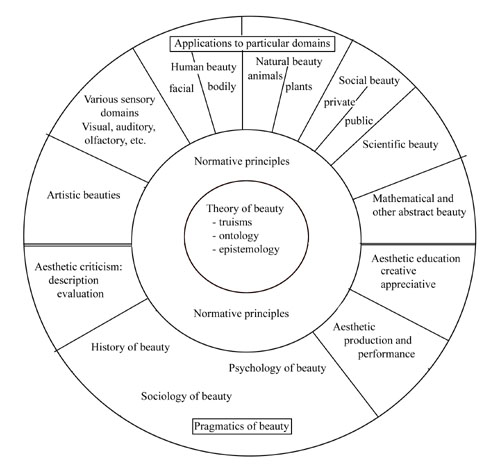
No diagram can contain all aspects of what we have discussed without all sorts of overlays, which would be too confusing. But you should note in the margins the important things not mentioned above. For instance the difference between the beauty of things and actions, and between outer things and our experiences. I think it will be useful to come back to the diagram from time to time to fit in the things we have been dealing with.
53. A further thought on bad reasons for subjectivism (or nihilism) about beauty. Another reason that sometimes leads people to deny the reality of beauty is that agreement about beauty is seldom all that important. Compare beauty with justice or other moral values. We believe it is highly important to develop a basis for correct moral judgments because social stability and harmony depend on agreement. Hence moral philosophers agonize over hard cases: should we allow late term abortions, should we feed ourselves by killing animals, and so forth. Questions about beauty aren't matters of life, death, guilt and remorse. Is this a reason to deny the objectivity of beauty and other aesthetic values? I don't see any logic in the idea that it is. Practical importance is no test of truth. What do you think?
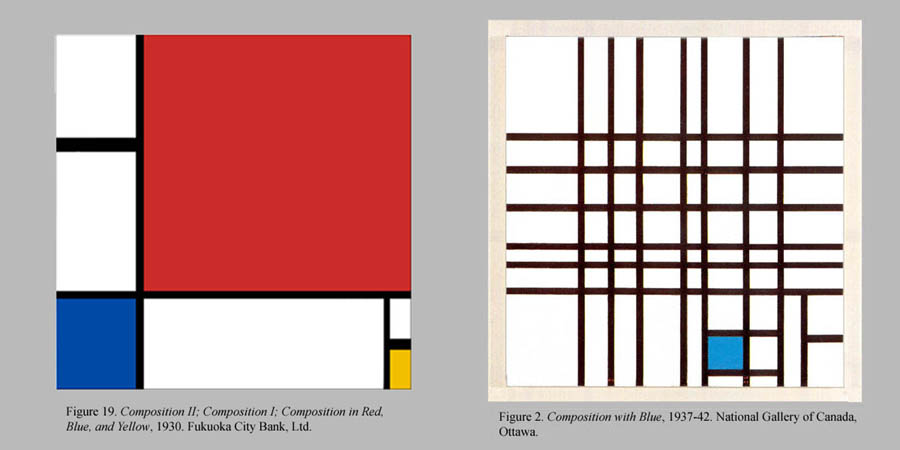
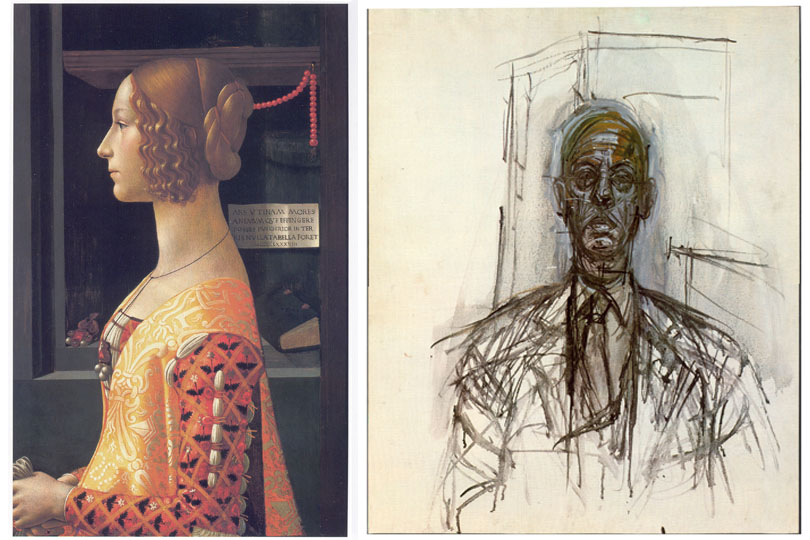
Left. Domenico
Ghirlandaio, Portrait of a Lady. Right.
Alberto Giacometti, Portrait of a Man
 Above. Giotto, Flight
into Egypt. c. 1305 (this image has had the colors partly
restored, since the original is now in an advanced state of deterioration).
Above. Giotto, Flight
into Egypt. c. 1305 (this image has had the colors partly
restored, since the original is now in an advanced state of deterioration).
Here is a glimpse of the original: 
Vittore Carpaccio. Flight into Egypt. 1500. (scroll down to number 20)
Domenico Feti, Flight into Egypt, 1621-23. (way farther down opposite "For use in Times of Natural Disaster")
Norman Rockwell, Swimming Hole, 1943. (Click New Prints and enter Simming Hole in selection space.)
Duccio di Buoninsegna, Flight into Egypt, 1308-11. (# 3 on the list)
55. Aesthetic Property Exercise. Test your intuitions about the properties listed in the questionnaire concerning the following three paintings.View using full screen setting. Record your impressions concerning them. If your intuitions suggest other relevant terms list them in your comments.
1. Raphael's School of Athens, 1512.
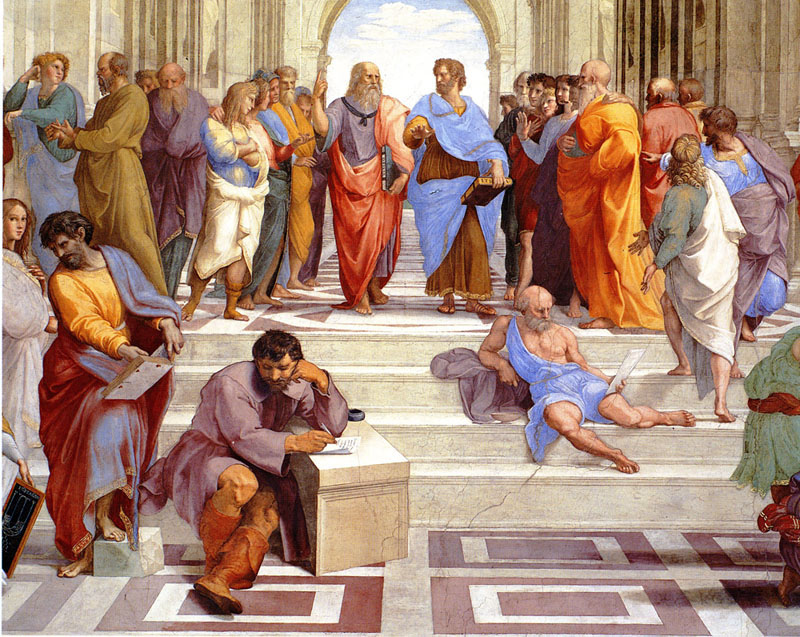 Which of the following paired terms applies?
1. Agitated___No_____ Calm___Yes_____
2. Confident__Yes____ Uncertain__No____
3. Weak_____No_____ Strong__Yes_____
4. Balanced___Yes____ Insecure___No______
5. Clearly ordered____Yes____ Confused____No______
The figures in particular are:
6. Robust____Yes____ Frail____No______
7. Purposeful___Yes___ Hesitant___No______
8. Affected___Mostly not*____ Natural___Mostly yes*___
The architecture (see the whole painting) is:
9. Apollonian___Yes___ Dionysian__No____
10. Pompous___No*___ Modest____No_____
The colors (in the detail) are:
11. Bold__No* ___ Tame____No_____
12. Harmonious___Yes___Gaudy__No_____
Comments. 8. Figures strike poses that to our eyes are somewhat artificial. But they are vigorous. The
total effect is that of some momentous occasion. 10. Architecture is imposing but it lifts us up rather than intimidates. (The whole painting is posted below, showing the architecture.) 11. Colors are strong enough to set each figure off but none is really bold. Restrained is a better overall description than timid. The overall effect is also certainly harmonious, not gaudy (not dull either).
2. Vincent Van Gogh, Starry Night.
Some of the forms in the painting:
1. Writhe manically_Yes_ Remain at rest_
No__
2. Writhe joyously__?__ Writhe in distress__?__
3. Move majestically_No_ Move nervously_Yes_
4. Heave like waves _Yes_ Shoot like lightning_No__
5. Quiver/tremble_Yes__Jerk/jump/zigzag__No__
6. Flicker__Not likely_ Glow/ burn___Yes_____
The painting as a whole is:
7. Exultant__Maybe___ Depressed__No_____
8. Ecstatic__Yes______ Meditative__No_____
9. Impulsive__Yes____ Measured___No____
10. Balanced__Yes____ Tottering, insecure__No___
The brush strokes are mostly:
11. Sinuous, graceful_No__ Stubby, awkward_Yes___
12. Careful__No?__ Hasty, urgent_ Yes____
Comments: 2. The emotional tone isn’t clear enough to justify joy or distress. Perhaps some of each.
6. The stars/planets certainly glow and pulsate. Flicker goes too far. 7. Ecstasy of some sort seems certain, exultation may be too positive.10. A fine example of asymmetric balance. 11. The sinuous lines are made up of stubby, inelegant dabs. 12. Not careless, certainly, but not clearly careful either.
Interposed: Cezanne's Still Life (discussed in the article on the home page)
3. Matisse, The
Egyptian Curtain, 1948.
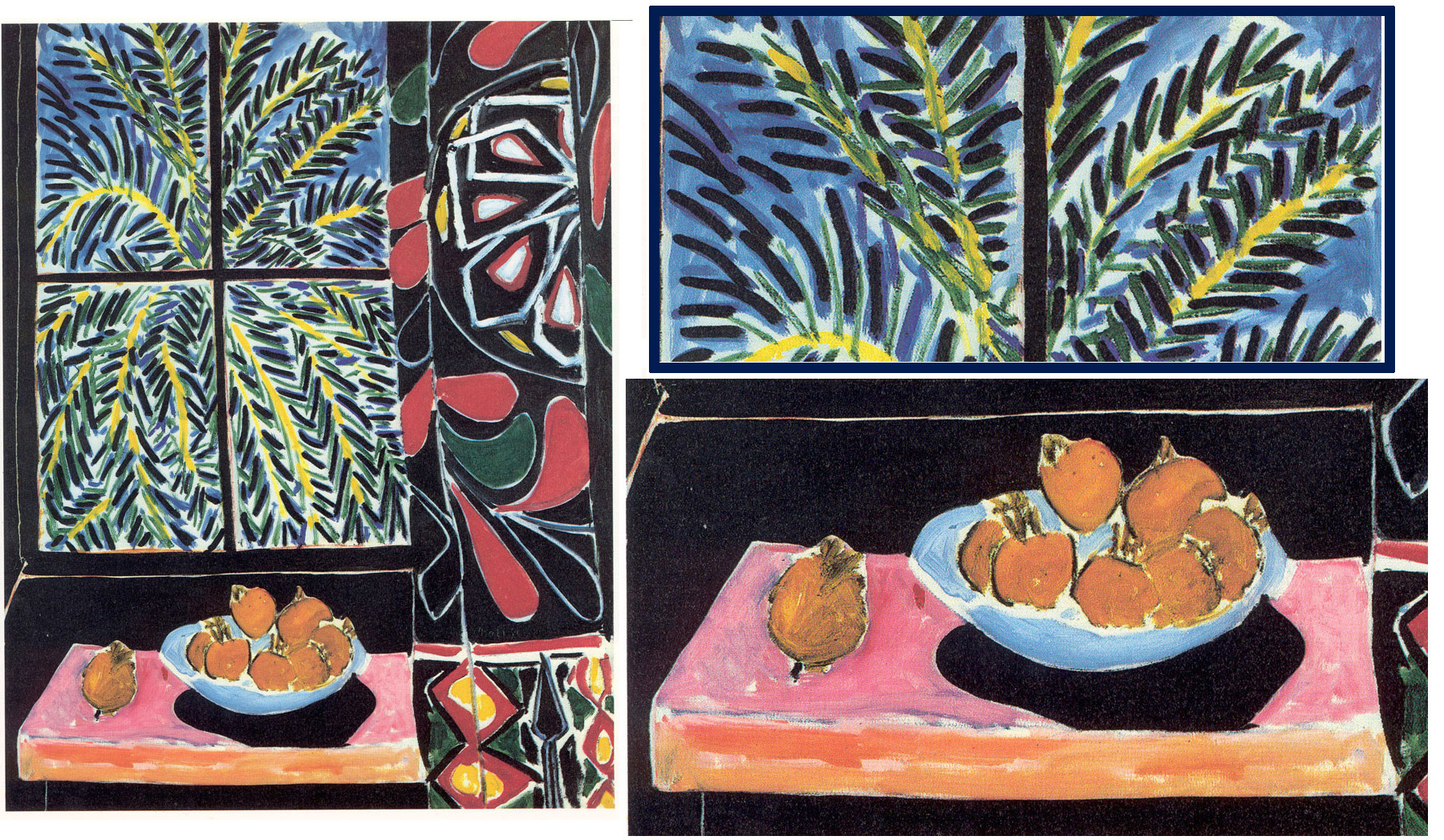
Re. Matisse's colors and forms
1. Are his colors hot, cool or neither?__The hot are very hot, the cool for contrast_
2. Are they harmonious or garish?___Overall vibrant, bold, rather than garish___
Esp. the pink and the orange. __Saved from being garish by black________
3. Is the light bright, dim or somewhere in between?__Incoming light bright against inky darks___
4. Are the textures in the table soft, hard, or what?__Soft, cushy, cottony (but unreal)_____
5. What shapes are given to the fruit?__Awkwardly angular, stiff_________
6. Is the palm expansive or contractive or neither?__strongly expansive_______
7. What terms describe the marks on the palm fronds?__stubby, staccato,____
Do they look lively or leaden? Bristly (Yes) or limp?_No: lively though heavy_______
Try comparing the strokes with music. Staccato, dry, percussive
Re. the painting as a whole
8. Is the painting overall tight or loose?_Loose in detail but tight and bold overall_________
Does it suggest thought or sensuous feeling?__sensuous feeling_________
Sharply focused or somewhat unfocused vision?__Unfocused immersion______
Comments: 3. Sparkle effect in palm from white areas. Similarly on edge of fruit and bowl.
8. Flattened, sketchy renderings suggest diffuse vision that doesn’t pick up details.
***************End of Exercise************************
Raphael,
The Miraculous Draught of Fishes,
1516.

Leonardo and Verroccio, Baptism of Christ, c. 1470.
56. Examples relevant to questions about the U&V or other criteria of beauty in natural organisms.
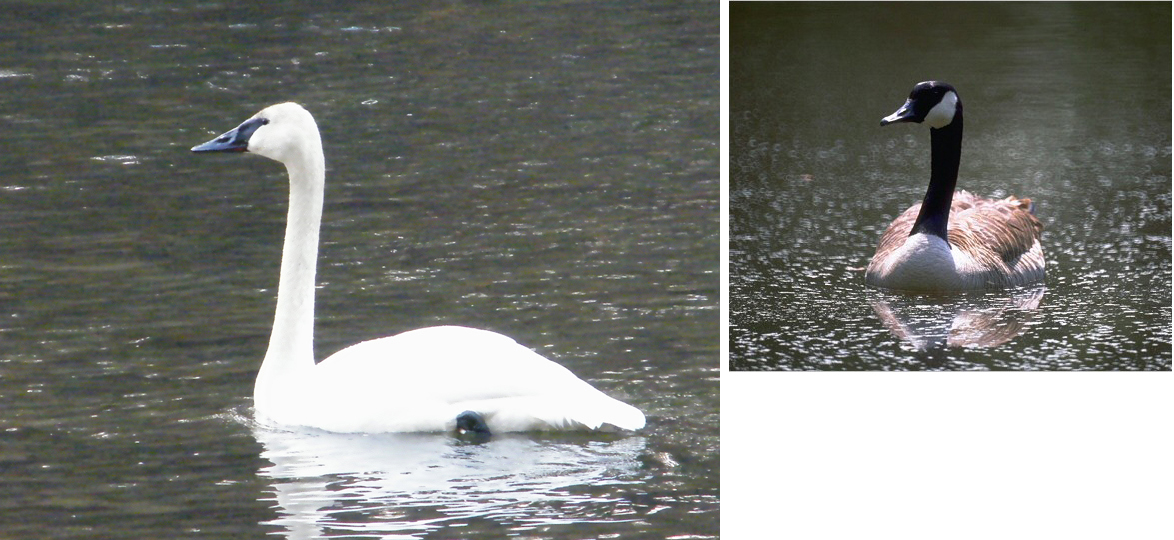
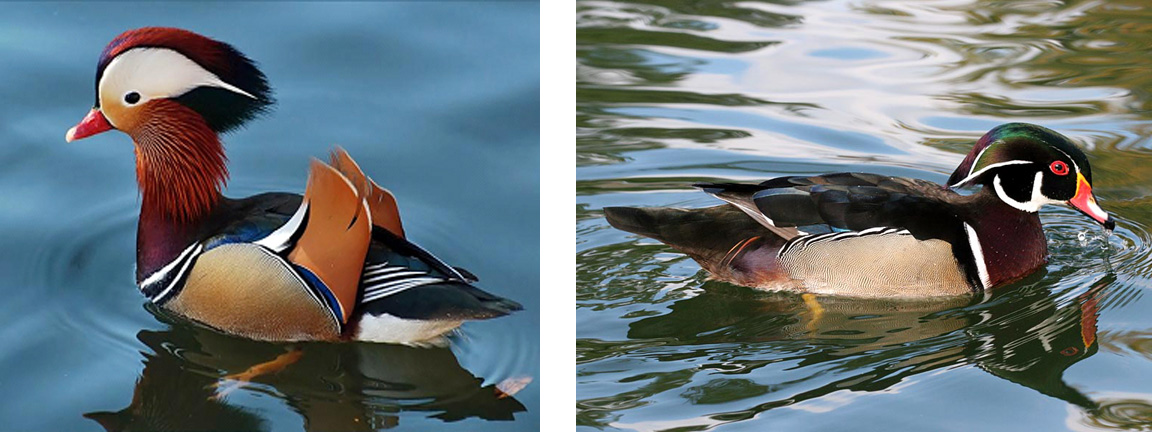
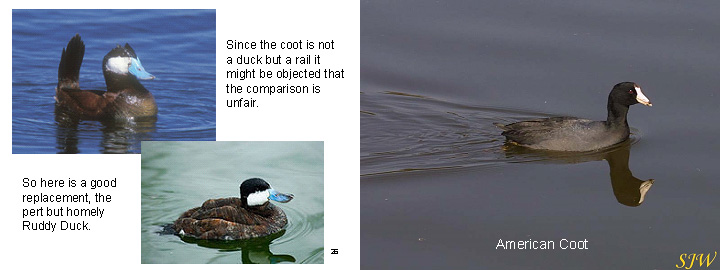
57. Visual balance: Mondrian options re. balance, from the ppt. presentation in lecture, plus a complication where gravity is a factor in the design.
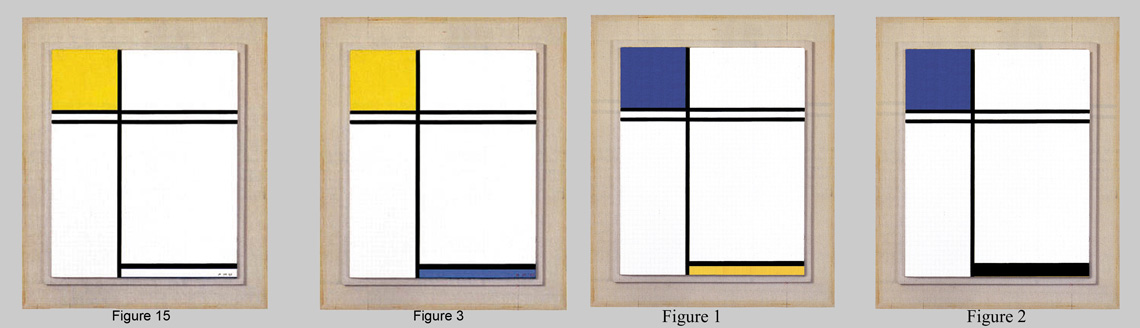
Which of the four is best balanced? How are the others off-balance? To which side or direction?
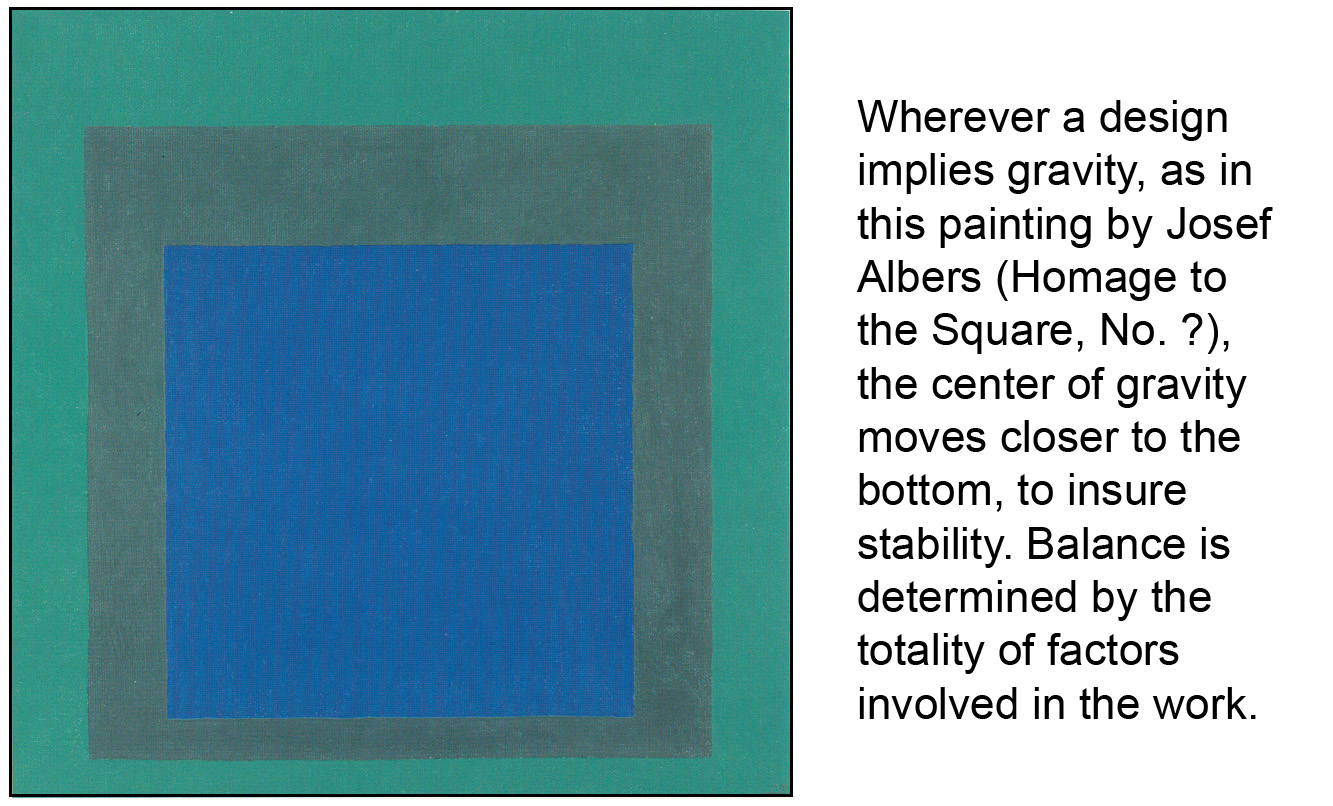
58. Further thoughts about the capacity of the different sensory modalities to provide artistic media.
(a) The volume of a sound is parallel to the brightness (or lightness) of a color. Pitch, timbre, and volume make up a set of sonic dimensions parallel to the three color dimensions (hue, saturation, lightness).
(b) What in visual fields is comparable to noise in sonic ones? Interesting question. Is graininess? And how is that related to texture? Texture can be very sharp and regular whereas graininess is usually assumed to be irregular -- and thus more like noise.
(c) Bats' echolocation capacity was brought up by one student as enabling them to perceive shape. Good point. But notice, it works only by a running stream of sonar clicks. Vision presents simultaneous as well as sequential shape information. That's a significant difference that makes vision far more informative. Also echolocation in bats is limited to single objects. Vision takes in a whole field, admittedly with selective focus but with the periphery also contributing significantly.
(d) The three-dimensional structure of color and tone is essential to the possibility of sonic and color composition. The lack of comparable structure in olfactory and gustatory elements seriously limits their composability (even apart from their other deficiencies). They have neither harmonic structure nor a single well-ordered spectrum. See Beauty Additions #11 for information about the properties of scent.
(e) Visual fields also have geometrical properties, which in turn enable pictorial representation and its counterpart in film, cinematic representation. Auditory fields lack geometry. But auditory fields (flows) are conspicuously rich in rhythm and dynamic properties. These help to give them the power to suggest spatial movement, muscular dynamism, and qualities of speech and thereby emotions, which serves them well in music. The latter is recognized by Plato in the Republic Bk.3.
Thus the full story of the powers and limitations of sensory modes in relation to art is interestingly complicated.
59. Paul Erdos, "the man who loved
only numbers." A brief account of this remarkable man's career
and character can be found at: http://www.nndb.com/people/401/000032305/ and http://www.math.technion.ac.il/newmath/erdos/
Erdos was perhaps as close to a paragon of Platonic
recollection as there is.
60. Pythagorean Theorem proved by a simple diagrammic demonstration.
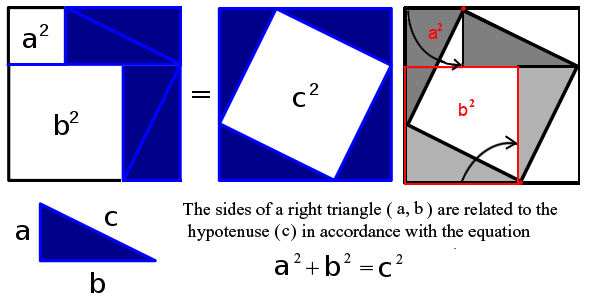
Can the beauty of the Pythagorean Theorem be explained via multiplicity of uniformities? (JB's attempt to explain how it can)
1. Suppose we discovered empirically some of the infinite set of Pythagorean triples but not the theorem. ( 3 , 4 , 5 ) ( 5, 12, 13) ( 7, 24, 25) ( 8, 15, 17) ( 9, 40, 41) (11, 60, 61) (12, 35, 37) (13, 84, 85) (16, 63, 65) (20, 21, 29) (28, 45, 53) (33, 56, 65) (36, 77, 85) (39, 80, 89) (48, 55, 73) (65, 72, 97) We might have achieved this by careful use of units of measurement applied to templates. We would have discovered a uniformity among all these triples.
2. This would be useful in marking out rectangular fields, a basic surveying task in agriculture. But only for those particular values. For other lengths we would have to estimate. Suppose we narrowed the unknowns by discovering that multiplying each member of a triple by an integer also guaranteed a right triangle, e.g. (6, 8, 10) (9, 12, 15) (12, 16, 20) etc. Such tables would be incomplete and cumbersome to rely on in architectural or agricultural surveying.
3. Discovering that all these and all fractional cases could be swept together in the simple formula given by the Pythagorean theorem would be a revelation. It could be established only by a formal proof, not by measurement. Pythagoras established an overarching uniformity among all those lesser uniformities. That would display a hierarchically integrated uniformity of uniformities in accordance with JB's proposed reinterpretation of Hutcheson's criterion. Does that make both theorem and system beautiful?
I think this kind of complex uniformity is worthy of admiring contemplation and therefore is beautiful.
Part of the appeal of mathematics seems to be that starting from something so basic and familiar as counting we are irresistably led on to more and more complexity. Counting leads to calculating, to adding, subtracting and dividing; the integers we use in simple calculations lead to an infinite set of integers, and also to fractions, which lead to irrationals and so on and on and on. The world of numbers is well-ordered and highly integrated -- algebra with geometry, for instance. And there are practical applications of advanced mathematics to the world, to science and technology. So it's terrifically potent.
A question of interest is whether anything in the world of mathematics is ugly. There seem to be plenty of things that are lackluster. That much seems entailed by praise for the special beauties, e.g., the golden section and all of its progeny.